

EDS 101: Understanding Hypermobility in the Hand Therapy Setting
abgelegt unter Diagnosen
EDS in the Hand Therapy Setting

General Overview:
Ehlers Danlos Syndrome (EDS) is a group of heritable connective tissue disorders caused by
genetic changes that affect collagen production, the protein responsible for strength and elasticity
in skin, ligaments and tendons (The Ehlers Danlos Society, 2016).
There are thirteen forms of EDS that each have their own set of features with distinct diagnostic
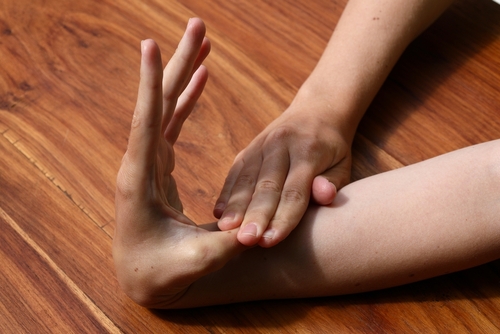
criteria. Of the thirteen the most common subtype of EDS is hypermobile Ehlers-Danlos
Syndrome (hEDS) which can include symptoms such as chronic muscle and Gelenkschmerzen,
subluxations/dislocations, joint pain, muscle pain, etc.
Many individuals also experience coexisting conditions that need to be considered during
evaluation and treatment planning, as these can significantly affect activity tolerance and
participation.
Common comorbidities include:
- Postural Orthostatic Tachycardia Syndrome (POTS) – A Condition that causes an
individual’s heart to beat faster than normal when transitioning from sitting or lying down
to standing up. POTS is a type of orthostatic intolerance that limits the body’s ability to
balance blood vessel constriction and heart rate response. (Clevland Clinic, 2022) - Fibromyalgia: A chronic health condition which causes pain and tenderness throughout
the body, often causing musculoskeletal pain and fatigue. (Clevland Clinic, 2022)
Treatment Goals and Focus:
The primary goals of therapy are to improve joint stability, strengthen and support function, not
to “fix” hypermobility, but to improve control and confidence in movement. - Therapeutische Übung: Brittian et al. (2024) reported that muscle strengthening and joint
position exercises to neutral and hyperextended ranges help to improve strength pain and
quality of life. - Schienung: Assists with stabilizing joints, reducing pain, and dislocation. Splints for EDS
can include plastic ring splints (oval 8 splints), silver ring splints, wrist supports and
stainless-steel ring splints. Jensen et al. (2020) found that finger orthoses may have a
positive effect on hand function for individuals with EDS. - Pain management strategies: Physical modalities, dry needling, and complementary
therapies may be incorporated to address chronic pain. - Patient education: Instruction on joint protection strategies, ergonomic modification and
energy conservation is essential. Brittian et al. (2024) explain there was an improved understanding of necessary lifestyle modification when there was a multimodal approach such as education on diagnosis and activity modification.
Why it Matters for Therapists:
Understanding EDS is crucial for clinicians because these clients often present with non-specific
pain and instability that may not fit the classic injury or overuse patterns that are taught. Early
recognition of hypermobility and connective tissue symptoms can help prevent unnecessary
interventions. Hakim (2018) emphasizes how occupational therapists can assist with assistive
devices, pain management tailored to symptoms, joint stability, and splints to improve alignment
and control.
Evidence shows that strengthening, joint protection, splinting, and patient education can
significantly improve function and quality of life for those with EDS. As a provider, it is
important that how we deliver care is just as important as what we deliver. By understanding the
patient’s unique presentation and tailoring interventions accordingly, therapists can help
individuals with EDS move and feel better.
Verweise
Brittain, M., Flanagan, S., Foreman, L., & Teran-Yengle, P. (2023). Physical therapy
interventions in generalized hypermobility spectrum disorder and hypermobile Ehlers-
Danlos syndrome: a scoping review. Disability and Rehabilitation, 46(10), 1–18.
https://doi.org/10.1080/09638288.2023.2216028
Cleveland Clinic. (2022). Fibromyalgia. Cleveland Clinic.
https://my.clevelandclinic.org/health/diseases/4832-fibromyalgia
Cleveland Clinic. (2022). Postural orthostatic tachycardia syndrome (POTS). Cleveland Clinic.
https://my.clevelandclinic.org/health/diseases/16560-postural-orthostatic-tachycardia-
syndrome-pots
Colin M.E. Halverson, Cao, S., Perkins, S. M., & Francomano, C. A. (2023). Comorbidity,
misdiagnoses, and the diagnostic odyssey in patients with hypermobile Ehlers-Danlos
Syndrome. Genetics in Medicine Open, 1(1), 100812–100812.
https://doi.org/10.1016/j.gimo.2023.100812
Hakim, A. (2018). Hypermobile Ehlers-Danlos Syndrome. Nih.gov; University of Washington,
Seattle. https://www.ncbi.nlm.nih.gov/books/NBK1279/
Jensen, A.-M., Andersen, J. Q., Quisth, L., & Ramstrand, N. (2020). Finger orthoses for
management of joint hypermobility disorders: Relative effects on hand function and
cognitive load. Prosthetics and Orthotics International, 030936462095686.
https://doi.org/10.1177/0309364620956866
Mast cell activation disorder Archives – The Ehlers-Danlos Support UK. (2024). The Ehlers-
Danlos Support UK. https://www.ehlers-danlos.org/what-is-eds/information-on-eds/mast-
cell-activation-disorder/
The Ehlers Danlos Society. (2016). The Ehlers-Danlos Society. The Ehlers Danlos Society.
https://www.ehlers-danlos.com/
Mehr zum Lesen

Karpaltunnelbehandlung: Nur Schienung vs. Schienung und konservative Behandlung
Kurzfristiges klinisches Ergebnis der Orthese allein im Vergleich zur Kombination aus Orthese, Nerven- und Sehnengleitübungen und Ultraschalltherapie zur Behandlung des Karpaltunnelsyndroms. Sim, Sze En et al. Journal of Hand Therapy, Band 32, Ausgabe 4, 411 – 416 Das Skinny-Carpal-Tunnel-Syndrom (CTS) ist die häufigste Kompressionsneuropathie. Komprimierung der…
Verändern Fettleibigkeit oder Rauchen die Ergebnisse bei Frakturen des distalen Radius?
Hall, Matthew J., Ostergaard, P., Dowlatshahi, A., Harper, C., Earp, B. Rozental, T. (2019). Der Einfluss von Fettleibigkeit und Rauchen auf die Ergebnisse nach Volarplattenfixierung von Frakturen des distalen Radius. Das Journal of Hand Surgery. Im Druck, korrigierter Beweis, online verfügbar am 31. Oktober 2019. Doi: https://doi.org/10.1016/j.jhsa.2019.08.017 Die Skinny-Distal-Radius-Frakturen sind eine der…
Gradierte motorische Bilder in der Handtherapie
Die 3 Stufen der Graded Motor Imagery Wir haben alle von der Spiegelbox-Therapie gehört, aber kennen Sie die Einzelheiten, wie sie funktioniert? Es gibt tatsächlich drei Stufen, die das Gehirn trainieren und seine Plastizität nutzen. Es gibt zahlreiche Beweise, die diese drei Phasen unterstützen, und Sie können sie nutzen …

Handtherapie als Studienanfänger oder Student
Tipps zur Vorbereitung auf die Handtherapie als Studienanfänger oder als Feldstudierender der Stufe II. Alles, was Sie über die Handtherapie wissen müssen, beginnt mit der Anatomie der oberen Extremitäten. Hier ist eine kurze Checkliste, die Sie durchgehen und Ihnen hoffentlich den Einstieg in Ihre neue Handtherapie-Umgebung erleichtern können. Von: Tristany Hightower Ich schlage vor, als…

Melden Sie sich an, um Updates direkt in Ihren Posteingang zu erhalten!
Melden Sie sich bei uns an und wir senden Ihnen regelmäßig Blogbeiträge zum Thema Handtherapie, Benachrichtigungen jedes Mal, wenn wir neue Videos und Tutorials hochladen, zusammen mit Handzetteln, Protokollen und anderen nützlichen Informationen.