

Effects of different stretching techniques for improving joint range of motion.
Filed under Reviews
Reference: Oba, K., Samukawa, M., Abe, Y., Suzuki, Y., Komatsuzaki, M., Kasahara, S., Ishida, T., & Tohyama, H. (2021). Effects of Intermittent and Continuous Static Stretching on Range of Motion and Musculotendinous Viscoelastic Properties Based on a Duration-Matched Protocol. International journal of environmental research and public health, 18(20), 10632. https://doi-org.libproxy.nau.edu/10.3390/ijerph182010632
The Skinny: This study used a cross-over design to explore the effects of two different stretching protocols, intermittent stretching protocol (INT) and continuous stretching protocol (CON), on musculotendinous properties and tissue extensibility. CON was performed for a duration of 120 seconds for one set and INT was performed for a duration of 30 seconds over four sets. Outcome measures included range of motion (ROM), passive resistive torque (PRT), and musculotendinous stiffness (MTS) and were evaluated before and after stretching. There were 18 male patients included in the study within 1.4 years of 22.7. The authors found that INT was statistically more effective than CON stretching at improving ROM and decreasing PRT. However, while MTS stiffness significantly decreased following both methods of stretching, there was no significant difference found between the methods. This study evaluated the motion of ankle dorsiflexion, however, the results are beneficial to keep in mind in an upper extremity setting when passively stretching clients.
In the Weeds: Inclusion criteria for this study was as follows:
- Young, healthy male
- No current lower limb injuries
- No history of neuromuscular disease
- Cannot regularly perform flexibility exercises or resistance training
- Refrain from intensive exercise for 24 hours prior to the beginning of the experiment
A Biodex System 3 isokinetic dynamometer was used to determine proper joint positioning and torque values with consistent positioning used for each participant. During the first of three sessions, the participants were familiarized with the study and the maximum tolerable torque threshold was recorded with the study participants pressing a button when maximum stretch was reached, without pain. During the following two visits either INT or CON stretching was completed around the same time of day with a minimum of 48 hours between the sessions. Maximum tolerable stretch measures were recorded at the initial visit with the following technique: the lever arm was moved at 1°/second from 20°of plantarflexion to maximum tolerable stretch in dorsiflexion in order to obtain maximum stretch without engaging a stretch reflex or muscle activity. These same measurement settings were used for both protocols at the following two sessions. A duration-matched protocol was used to ensure the same amount of time under stretch at the joint. The INT protocol used 4 sets of 30 seconds of stretch with a 15-second rest interval between each of the sets while the CON protocol was a 120-second stretch, with both protocols equating to a total of 120 seconds spent stretching the joint. Outcome measures used were as follows:
- PRT: passive resistance at the joint produced by the musculotendinous complex (calculated at the same angle of dorsiflexion before and after testing)
- MTS: the relationship between the amount of torque and the joint angle (calculated at the same angle of dorsiflexion before and after testing)
- ROM: measured at the predetermined maximum tolerable torque threshold
Bringing It Home:
Results:
The study found the following effects of CON versus INT on ROM, PRT, and MTS:
- ROM: There were no significant differences in participant ROM prior to stretching. Following stretching, ROM was significantly increased for both CON and INT stretching protocols. However, ROM was significantly higher following INT compared to CON.
- PRT: Both CON and INT resulted in a significant decrease in PRT, though INT resulted in a significantly larger effect size than CON.
- MTS: While there was no significant two-way interaction between condition and time for MTS, a main effect of time was found with MTS significantly decreasing after both INT and CON. No significant difference between the two protocols was observed.
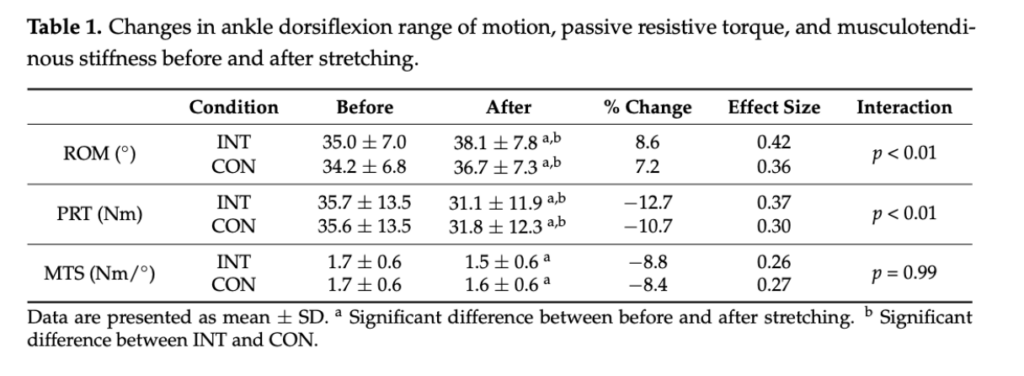
Conclusions: This study suggests that INT and CON stretching both decreased MTS, however, INT stretching improved ROM and decreased PRT at a significant difference compared to CON stretching. INT stretching can be seen as a more effective technique for use in the clinic.
Rating: This study was thoughtfully and strategically implemented with few limitations. Limitations included the lack of specifying activity levels and exercise habits of the study participants and the population characteristics (age, sex, activity level, exercise habits, etc.) having a possible influence on the outcomes. While this study evaluates the effectiveness of stretching on the ankle joint, the results of the study are important to take into consideration when providing passive stretching while working with the upper extremity as well. As practitioners, it is important to use best practices when treating our patients and this study demonstrates the positive effects of INT stretching on musculotendinous properties and may be used to improve patient outcomes in the clinic. Study rating: 5/5.
More To Read

Wrist Fractures and Marijuana Use: What are the complications?
Title: Marijuana use and complications with healing after distal radius wrist fracture Article: Livesey, M. G., Bains, S. S., Stern, J. M., Chen, Z., Dubin, J. A., Monárrez, R., … & Ingari, J. V. (2025). Cannabis use in patients with distal radius fractures: a moment of unity?. Hand, 20(2), 263-268. The skinny The impact of tobacco use…

Why Scar Massage Matters After Hand Surgery
After hand surgery or an upper extremity injury, most people expect some pain, swelling, and stiffness. What patients do not always expect is how much a scar can affect movement and comfort. Even when an incision looks healed on the outside, the tissue underneath may still feel tight, sensitive, or restricted. This is where scar…

Video Augmented Hand Therapy after CVA with hemiplegia.
The previous rapid review discussed the positive outcomes of video-augmented hand therapy after a CVA with hemiplegia. Please watch this vlog to discover how to make the video augmented box to make it easily integrated into your clinic. Video By: Shannon Skowbo
IFC vs TENS: Electrical Stimulation for Pain and Swelling
In this article we’re looking at the difference between Inferential Current versus Transcutaneous Electric Nerve Stimulation (IFC vs TENS). Transcutaneous Electric Nerve Stimulation (TENS) TENS variations are often described by their technical characteristics: high frequency, low intensity (conventional TENS) or low frequency, high intensity (acupuncture-like TENS, AL-TENS) (Walsh et al., 2009). How TENS Addresses Pain:…

Sign-up to Get Updates Straight to Your Inbox!
Sign up with us and we will send you regular blog posts on everything hand therapy, notices every time we upload new videos and tutorials, along with handout, protocols, and other useful information.