

Ultimate Guide to Continuing Education Credits for Occupational Therapists in 2025
Filed under Uncategorized
Introduction to Continuing Education for Occupational Therapists
In today’s fast-evolving healthcare landscape, continuing education credits for occupational therapists aren’t just a requirement—they’re a pathway to career advancement and improved patient care. Whether you’re renewing your license or specializing in a niche, staying current with the latest research, tools, and therapeutic techniques is vital.
Continuing education ensures occupational therapists remain competent, compliant, and competitive in their field. But what exactly are these credits? How do you earn them? What counts and what doesn’t? This guide will answer all that and more.
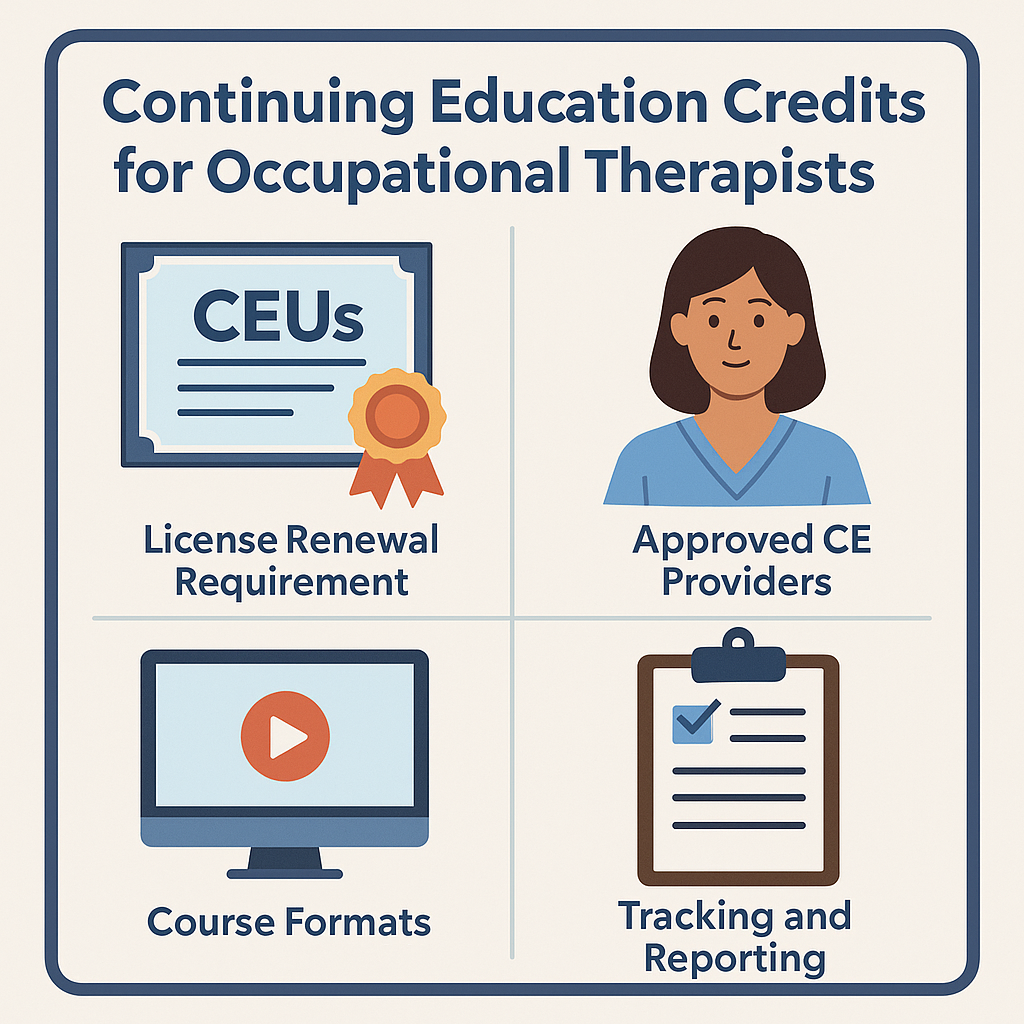
What Are Continuing Education Credits?
Continuing education credits—often abbreviated as CEUs (Continuing Education Units) or CEs (Continuing Education Credits)—are units used to measure participation in post-licensure learning activities.
CEU vs. CME vs. CEC – What’s the Difference?
- CEU (Continuing Education Unit): Typically, one CEU equals 10 hours of instruction. Occupational therapists commonly refer to credits as CEUs.
- CME (Continuing Medical Education): More common among physicians but occasionally applicable to interprofessional education.
- CEC (Continuing Education Credit): A general term often used interchangeably with CEU in many states and organizations.
The key is ensuring that the credit type you’re earning is accepted by your state licensing board or the National Board for Certification in Occupational Therapy (NBCOT).
Why Continuing Education Is Crucial in Occupational Therapy
Continuing education is more than fulfilling a requirement—it’s about growing as a clinician. Here’s why it’s indispensable:
- Compliance with License Renewal
Most states mandate a specific number of CEUs to maintain licensure. - Improved Patient Outcomes
Learn the latest interventions and evidence-based practices. - Professional Advancement
Expand into specializations or leadership roles through focused training. - Ethical Practice
Stay informed about new laws, policies, and ethical standards.
State Licensing Board Requirements (USA)
Each U.S. state has unique requirements. For example:
| State | CEU Requirement | Cycle |
| California | 24 contact hours | Every 2 years |
| Texas | 30 contact hours | Every 2 years |
| New York | 36 hours | Every 3 years |
| Florida | 26 hours + 2 hours ethics | Every 2 years |
Check your state’s occupational therapy board for exact guidelines: Federation of State Boards for Physical Therapy (FSBPT).
Approved CE Providers and Accreditation Bodies
Make sure your CEU provider is accredited. The most recognized authorities include:
- AOTA (American Occupational Therapy Association)
- NBCOT (National Board for Certification in Occupational Therapy)
- State Licensing Boards
- Academic Institutions and Teaching Hospitals
A course must have clear learning objectives, instructor credentials, and post-test evaluations to be valid.
Popular Continuing Education Formats
There’s flexibility in how OTs can earn CE credits:
- Live In-Person Workshops
Interactive and hands-on; great for networking. - Online Self-Paced Courses
Accessible anytime, perfect for busy professionals. - Live Webinars
Combines convenience with real-time engagement. - Conferences and Symposia
Earn bulk CEUs while exploring industry innovations.
Free vs. Paid CEU Options for Occupational Therapists
Is it possible to get CEUs for free? Yes—but with caveats:
Free CEUs
- Often offered by nonprofits or government-funded programs
- Usually limited in scope and less interactive
- May not be accepted in all states
Paid CEUs
- Broader variety and deeper specialization
- Includes certificates and transcripts
- Often provides higher production value and expert instructors
Specialty Areas and Advanced Certifications
OTs can specialize and earn additional CEUs while pursuing certifications in:
- Pediatrics (SIPT, SOS Approach)
- Geriatrics (Fall Prevention, Cognitive Rehab)
- Neurorehabilitation (Stroke, TBI)
- Mental Health (CBT, Trauma-Informed Care)
Each specialty area typically offers its own structured CEU pathway.
How to Track and Report CE Credits
Efficient tracking prevents last-minute panic during license renewal:
- Use tools like CE Broker or NBCOT Navigator
- Keep a CEU journal with dates, titles, and certificates
- Ensure courses match your state’s category requirements (e.g., ethics, evidence-based)
International CEU Recognition and Transfer
If you’re an OT trained or practicing outside the U.S.:
- Canada and the UK often accept U.S. CEUs, especially AOTA-approved ones.
- Check with regulatory bodies like HCPC (UK) or CAOT (Canada).
- Some U.S. states may also recognize international credits if equivalency is proven.
Employer and Institutional Support for CE
Many employers offer:
- Reimbursement for CEUs
- Paid time off for educational events
- On-site training or guest lectures
Talk to your HR or education coordinator to explore what’s available.
CEU Deadlines and Renewal Cycles
Typical license renewal cycles are every 2–3 years. Best practices include:
- Spread your CEUs across the cycle
- Don’t rely on last-minute cramming
- Verify deadlines with your state board
Mistakes to Avoid When Earning CEUs
Avoid these pitfalls:
- Taking unapproved courses
- Misreporting hours
- Overlapping CEUs for multiple licenses (some states disallow this)
- Forgetting ethics or state-specific requirements
Tips to Maximize CEU Learning Outcomes
- Choose relevant topics that align with your clinical work
- Take notes and reflect on implementation in practice
- Join peer study groups for discussion and retention
- Integrate learning goals into your professional development plan
Future Trends in OT Continuing Education
Continuing education is evolving. Expect to see:
- Microlearning: Short, focused lessons perfect for mobile devices
- VR/AR Training: Simulate patient scenarios in real-time
- AI-Powered Learning Paths: Personalized recommendations based on your role and goals
- Gamification: Earn CEUs through interactive case studies and quizzes
Frequently Asked Questions
1. How many CEUs do I need to renew my OT license?
It varies by state, but typically between 20–36 hours every 2–3 years.
2. Can I use the same CEUs for multiple licenses?
Only if each state or board accepts that course. Always verify.
3. Are online CEUs accepted?
Yes, if they’re from an approved provider and meet state criteria.
4. Do I need to submit certificates with my renewal?
Usually not, but you must keep records in case of an audit.
5. Are AOTA-approved courses accepted nationwide?
Mostly, but check your state board’s specific rules.
6. Can I earn CEUs while working abroad?
Yes, if the provider is internationally recognized or your state allows it.
Conclusion
Earning continuing education credits for occupational therapists isn’t just a regulatory necessity—it’s a professional opportunity. With so many flexible options available, you can grow your expertise, explore new specialties, and continue delivering top-tier patient care.
Remember to plan early, choose reputable courses, and stay informed about your state’s requirements. Lifelong learning is the key to thriving in occupational therapy.
More To Read
Peripheral nerve injury: A hand therapist’s assessment of sensory return.
Sensory return after a hand injury specifically a peripheral nerve injury After a peripheral nerve injury, there are often times impairments in sensory function and/or motor function. The rate of recovery varies based on the degree of injury, the overall health of the patient, and the patient’s age. After an injury, it is important…

Top 6 treatments for Pinky Fractures
Clients who have experienced a fracture of the finger or hand often find it difficult to participate in meaningful occupations. Everyday tasks from grasping items, cutting food, taking lids off containers, turning keys, and many others can be very painful. Pinky fracture is particularly challenging and painful. This is typical because the largest contributor to…

Comparison of Erb’s Palsy and Klumpke’s Palsy: Symptoms, Presentation, and Treatment Options
What is the brachial plexus? The brachial plexus is a group of nerves originating from the cervical and thoracic nerve roots (from C5 to T1). The brachial plexus forms 5 peripheral nerves of the upper extremity, consisting of the musculocutaneous, median, radial, ulnar, and axillary nerves. This group of nerves supplies motor and sensory innervation…

Comparing IP and MCP joint splinting for Trigger Finger
Teo, S. H., Ng D. C., Wong, Y.K.(2018). Effectiveness of proximal interphalangeal joint blocking orthosis vs metacarpophalangeal joint blocking orthosis in trigger digit: A randomized clinical trial. Journal of Hand Therapy, 1-7. The Skinny- This study compared PIP joint immobilization via an Oval-8TM with a custom MCP blocking orthosis in the treatment of trigger finger. …

Sign-up to Get Updates Straight to Your Inbox!
Sign up with us and we will send you regular blog posts on everything hand therapy, notices every time we upload new videos and tutorials, along with handout, protocols, and other useful information.