

EDS 101: Understanding Hypermobility in the Hand Therapy Setting
Classé sous Diagnostics
EDS in the Hand Therapy Setting

General Overview:
Ehlers Danlos Syndrome (EDS) is a group of heritable connective tissue disorders caused by
genetic changes that affect collagen production, the protein responsible for strength and elasticity
in skin, ligaments and tendons (The Ehlers Danlos Society, 2016).
There are thirteen forms of EDS that each have their own set of features with distinct diagnostic
criteria. Of the thirteen the most common subtype of EDS is hypermobile Ehlers-Danlos
Syndrome (hEDS) which can include symptoms such as chronic muscle and douleur articulaire,
subluxations/dislocations, joint pain, muscle pain, etc.
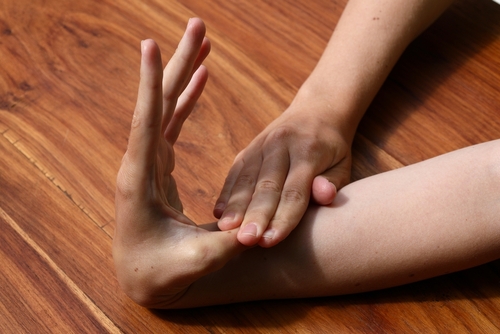
Many individuals also experience coexisting conditions that need to be considered during
evaluation and treatment planning, as these can significantly affect activity tolerance and
participation.
Common comorbidities include:
- Postural Orthostatic Tachycardia Syndrome (POTS) – A Condition that causes an
individual’s heart to beat faster than normal when transitioning from sitting or lying down
to standing up. POTS is a type of orthostatic intolerance that limits the body’s ability to
balance blood vessel constriction and heart rate response. (Clevland Clinic, 2022) - Fibromyalgia: A chronic health condition which causes pain and tenderness throughout
the body, often causing musculoskeletal pain and fatigue. (Clevland Clinic, 2022)
Treatment Goals and Focus:
The primary goals of therapy are to improve joint stability, strengthen and support function, not
to “fix” hypermobility, but to improve control and confidence in movement. - Exercice thérapeutique: Brittian et al. (2024) reported that muscle strengthening and joint
position exercises to neutral and hyperextended ranges help to improve strength pain and
quality of life. - Attelle: Assists with stabilizing joints, reducing pain, and dislocation. Splints for EDS
can include plastic ring splints (oval 8 splints), silver ring splints, wrist supports and
stainless-steel ring splints. Jensen et al. (2020) found that finger orthoses may have a
positive effect on hand function for individuals with EDS. - Pain management strategies: Physical modalities, dry needling, and complementary
therapies may be incorporated to address chronic pain. - Patient education: Instruction on joint protection strategies, ergonomic modification and
energy conservation is essential. Brittian et al. (2024) explain there was an improved understanding of necessary lifestyle modification when there was a multimodal approach such as education on diagnosis and activity modification.
Why it Matters for Therapists:
Understanding EDS is crucial for clinicians because these clients often present with non-specific
pain and instability that may not fit the classic injury or overuse patterns that are taught. Early
recognition of hypermobility and connective tissue symptoms can help prevent unnecessary
interventions. Hakim (2018) emphasizes how occupational therapists can assist with assistive
devices, pain management tailored to symptoms, joint stability, and splints to improve alignment
and control.
Evidence shows that strengthening, joint protection, splinting, and patient education can
significantly improve function and quality of life for those with EDS. As a provider, it is
important that how we deliver care is just as important as what we deliver. By understanding the
patient’s unique presentation and tailoring interventions accordingly, therapists can help
individuals with EDS move and feel better.
Les références
Brittain, M., Flanagan, S., Foreman, L., & Teran-Yengle, P. (2023). Physical therapy
interventions in generalized hypermobility spectrum disorder and hypermobile Ehlers-
Danlos syndrome: a scoping review. Disability and Rehabilitation, 46(10), 1–18.
https://doi.org/10.1080/09638288.2023.2216028
Cleveland Clinic. (2022). Fibromyalgia. Cleveland Clinic.
https://my.clevelandclinic.org/health/diseases/4832-fibromyalgia
Cleveland Clinic. (2022). Postural orthostatic tachycardia syndrome (POTS). Cleveland Clinic.
https://my.clevelandclinic.org/health/diseases/16560-postural-orthostatic-tachycardia-
syndrome-pots
Colin M.E. Halverson, Cao, S., Perkins, S. M., & Francomano, C. A. (2023). Comorbidity,
misdiagnoses, and the diagnostic odyssey in patients with hypermobile Ehlers-Danlos
Syndrome. Genetics in Medicine Open, 1(1), 100812–100812.
https://doi.org/10.1016/j.gimo.2023.100812
Hakim, A. (2018). Hypermobile Ehlers-Danlos Syndrome. Nih.gov; University of Washington,
Seattle. https://www.ncbi.nlm.nih.gov/books/NBK1279/
Jensen, A.-M., Andersen, J. Q., Quisth, L., & Ramstrand, N. (2020). Finger orthoses for
management of joint hypermobility disorders: Relative effects on hand function and
cognitive load. Prosthetics and Orthotics International, 030936462095686.
https://doi.org/10.1177/0309364620956866
Mast cell activation disorder Archives – The Ehlers-Danlos Support UK. (2024). The Ehlers-
Danlos Support UK. https://www.ehlers-danlos.org/what-is-eds/information-on-eds/mast-
cell-activation-disorder/
The Ehlers Danlos Society. (2016). The Ehlers-Danlos Society. The Ehlers Danlos Society.
https://www.ehlers-danlos.com/
Plus à lire
L'utilisation de la stimulation électrique neuromusculaire avec la paralysie des membres supérieurs
L'utilisation de la stimulation électrique neuromusculaire avec la paralysie des membres supérieurs Par : Mikayla Murphy Martin, R., Johnston, K. et Sadowsky, C. (2012). Entraînement à la préhension assisté par stimulation électrique neuromusculaire et restauration de la fonction de la main tétraplégique : une série de cas. Le Journal américain d'ergothérapie, 66(4), 471-477. https://doi.org/10.5014/ajot.2012.003004 The Skinny Le but de l'étude était de…
Quelle conception d'orthèse est la meilleure pour les blessures aux tendons extenseurs de la zone 5-6, une orthèse à mouvement relatif par rapport à une orthèse d'extension dynamique ?
M. Buhler, ˝ D. Gwynne-Jones, M. Chin et al., (2023) Les résultats des orthèses d'extension à mouvement relatif sont-ils non inférieurs et rentables par rapport aux orthèses d'extension dynamique pour la gestion des zones V-VI des réparations des tendons extenseurs des doigts : Un essai contrôlé randomiséJournalofHandTherapy. The Skinny : Le but de cette étude était de comparer les données de deux types d’orthèses différents…
7 conseils pour vos patients souffrant d'arthrose !
7 conseils pour vos patients arthrosiques ! Gérer l'arthrose de la main Nos mains constituent l'une des structures les plus complexes du corps humain. Ils sont composés d’un réseau de tendons, de ligaments et de nerfs qui permettent d’effectuer des tâches quotidiennes comme déverrouiller une porte, éplucher un œuf ou encore envoyer un email…
Quelle est l’efficacité de l’IASTM ?
Citation Kim, J., Sung, DJ, Lee, J. (2017). Efficacité thérapeutique de la mobilisation des tissus mous assistée par instruments pour les lésions des tissus mous : mécanismes et application pratique. Journal de réadaptation par l'exercice, 13(1). doi : https://doi.org/10.12965/jer.1732824.412 L'IASTM maigre est une technique relativement simple qui utilise la surface d'un instrument pour minimiser la quantité de pression ou de force nécessaire…

Inscrivez-vous pour recevoir des mises à jour directement dans votre boîte de réception !
Inscrivez-vous avec nous et nous vous enverrons régulièrement des articles de blog sur tout ce qui concerne la thérapie des mains, des notifications chaque fois que nous mettons en ligne de nouvelles vidéos et tutoriels, ainsi que des documents, des protocoles et d'autres informations utiles.