

By: Sophia Grimm
Hand burns can be very challenging to treat, and successful rehabilitation begins early after acute injury. Following a burn injury, scar contractures are the primary reason for the deformity of the hand. Therefore, proper orthotic intervention is key to preventing joint and ligament contractures (Kelly, Berenz & Williams, 2019). Splinting goals following a burn injury change depending on the stage of healing. In the acute stage where the wounds are 50% closed or skin, grafting has begun, static orthoses are used for positioning, edema management, and contracture prevention. The intermediate stage of wound healing is from about 50% of wound closure to complete wound closure and consists of static orthoses, static progressive orthoses, and/or dynamic orthoses. During the intermediate stage, orthotic intervention is used for positioning, tissue stretching, and lengthening to prevent contracture formation. The long-term stage of healing is from wound closure to maximal benefit and outcome of rehabilitation. During this phase, static progressive and dynamic orthoses are used to provide stretch, promote tissue gliding, decrease stiffness, and strengthen weakened structures (Kelly, Berenz & Williams, 2019).
The type of orthosis used for a hand burn depends on the location of the burn and the anticipated deformity. Typical deformities seen in hand burns include; hyperextension of the MCP’s, flexion deformity of the IP’s, loss of transverse metacarpal arch, adduction contracture of the thumb, wrist flexion contracture, and shortening of the dorsal skin (dorsal hand burn) (Kelly, Berenz & Williams, 2019).
A patient with a burn on the dorsum of the hand will require an orthosis that positions the hand in the angle antideformity (intrinsic plus position, antideformity position of hand). The most common deformity following a dorsal hand burn is a clawhand. The dorsal surface of the hand is thin and highly mobile, which allows for extensor tendon gliding. When a burn occurs in this area, extensor tendons are prone to subsequent injury resulting in deformities such as matter finger, boutonnière deformity, or swan neck deformity. To prevent deformity, the hand should be positioned with the wrist in 15 to 30 degrees of extension, the MCP joints in 70 to 80 degrees of flexion, the IP joints straight, and the thumb abducted. This position preserves the hand’s arch and places the MCP collateral ligaments in a maximal stretch position.
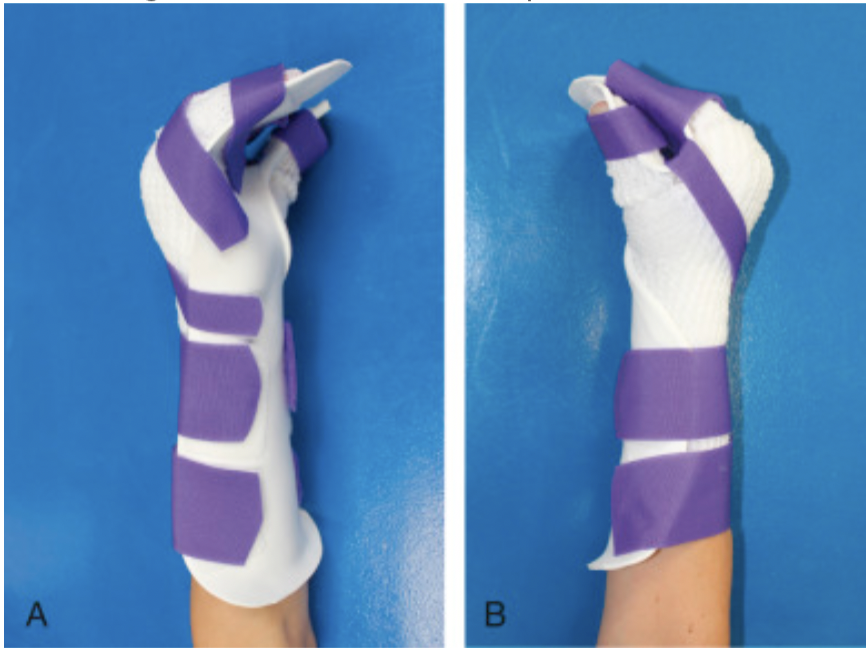
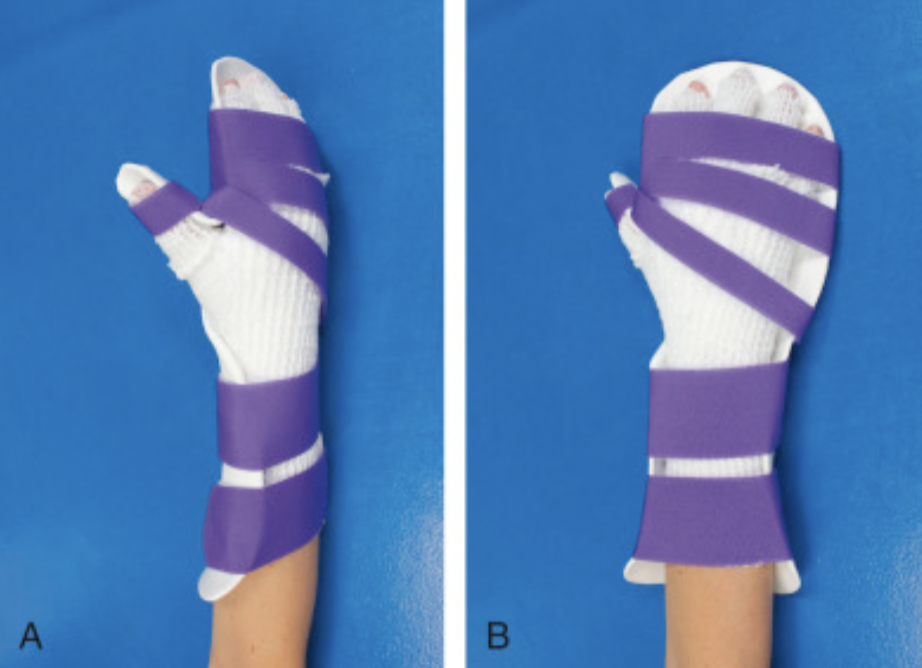
Kelly, B. M., Berenz, T., & Williams, T. (2019). Orthoses for the Burned Hand. Atlas of Orthoses and Assistive Devices. doi:10.1016/b978-0-323-48323-0.00015-9
Palmar hand burns should be positioned in a palmar extension splint to prevent flexion contractures. The palmar burn’s antideformity position consists of wrist extension, MCP joint extension, IP joint extension, digital abduction, and thumb abduction and extension. Palmar burns frequently result in the loss of the first webspace, thus compromising the thumb’s use.
Circumferential hand burns will require splinting in alternating positions to include intrinsic plus position and palmar extension position each day. Individuals with circumferential burns are at an increased risk of compartment syndrome and subsequent musculoskeletal and nerve damage.
Patients with limited AROM will also benefit from dynamic orthoses once wound closure has occurred. Depending on the injury, a patient may benefit from a dynamic digit flexion orthosis or extension orthosis. Both may be used in conjunction for circumferential hand burns.
Webspace contractures are common with palmar and circumferential burns. This results in limited motion of the thumb. To prevent a webspace adduction contracture, a C-bar orthosis may be used. Interdigital inserts are also used to prevent contracture formation in between digits.
In conclusion, rehabilitation of hand burns is very challenging and early treatment in the acute phase of the injury is important to maximize functional outcomes. Orthotic intervention is key in contracture prevention, edema management, and scar management throughout all phases of wound healing.
HealthPartners. (n.d.). Burn splints: Regions Hospital. Retrieved December 02, 2020, from https://www.healthpartners.com/hospitals/regions/specialties/burn-center/splints/
Kelly, B. M., Berenz, T., & Williams, T. (2019). Orthoses for the Burned Hand. Atlas of Orthoses and Assistive Devices. doi:10.1016/b978-0-323-48323-0.00015-9
1 Comment
Leave a Comment
More To Read
The Use of Neuromuscular Electrical Stimulation with Upper Extremity Paralysis
The Use of Neuromuscular Electrical Stimulation with Upper Extremity Paralysis By: Mikayla Murphy Martin, R., Johnston, K., & Sadowsky, C. (2012). Neuromuscular electrical stimulation–assisted grasp training and restoration of function in the tetraplegic hand: A case series. The American Journal of Occupational Therapy, 66(4), 471-477. https://doi.org/10.5014/ajot.2012.003004 The Skinny The purpose of the study was to…

Stretching Alone Can Change P1 Bone Shape in Patients with Camptodactyly
Woo Hong, S. Kim, J., Sang Kwon, O., Ho Lee, M., Sik Gong, H., Hyun Baek, G., (2019). Radiographic Remodeling of the Proximal Phalangeal Head Using a Stretching Exercise in Patients With Camptodactyly. J Hand Surg Am, 1.e1-1.e10 The Skinny – Camptodactyly is a congenital, nontraumatic flexion contracture of the PIP in fingers other than…
Tommy John Injury: Journey Back to Throwing after a UCL Injury
Anatomy of Ulnar Collateral Ligament (UCL) Originating on the anteroinferior surface of the medial epicondyle of the humerus and inserting onto the sublime tubercle of the ulna, the ulnar collateral ligament (UCL), also known as the medial collateral ligament (MCL), is crucial in providing support to the medial aspect of the elbow by restraining valgus…
Outcomes of Rigid Night Splinting and Activity Modification in the Treatment of Cubital Tunnel Syndrome
Shah, C. M., Calfee, R. P., Gelberman, R. H., & Goldfarb, C. A. (2013). Outcomes of rigid night splinting and activity modification in the treatment of cubital tunnel syndrome (night splint for cubital tunnel syndrome). The Journal of Hand Surgery, 38(6), 1125–1130.e1. https://doi.org/10.1016/j.jhsa.2013.02.039 By: Sophia Grimm The Skinny: The purpose of this study was to…

Sign-up to Get Updates Straight to Your Inbox!
Sign up with us and we will send you regular blog posts on everything hand therapy, notices every time we upload new videos and tutorials, along with handout, protocols, and other useful information.
What would you else recommend that I read to learn more about this topic and related