

Efficacy of Virtual Reality Rehabilitation after Spinal Cord Injury: A Systematic Review
Filed under Treatments
De Araújo, A. V. L., Neiva, J. F. D. O., Monteiro, C. B. D. M., & Magalhães, F. H. (2019). Efficacy of virtual reality rehabilitation after spinal cord injury: A systematic review. BioMed Research International, 2019(1), 7106951. https://doi.org/10.1155/2019/7106951
Efficacy of Virtual Reality Rehabilitation after Spinal Cord Injury
Emilee Sanders, OTS
The Skinny:
Virtual reality (VR) rehabilitation may help individuals with spinal cord injury (SCI) improve motor function, motor skills, balance, and aerobic function and reduce pain either as a standalone intervention or in conjunction with rehabilitation therapies. This is a first systematic review of its kind concerning the effectiveness of VR and SCI in rehabilitation.

In the Weeds:
The systematic review includes 25 studies which contained randomized controlled trials, nonrandomized controlled trials, quasi experimental studies, and before and after studies.
Participant inclusion criteria: Male and Female participants aged 18-65 years with spinal cord injury (traumatic or nontraumatic) who participated in immersive or non immersive VR-based therapy.
Two reviewers extracted data based on participant characteristics, study characteristics, methodological details, VR effects, bias risk, size effects, statistical power, and limitations.
The reviewers used a p value of < 0.05 to assess whether the effects of VR-based rehabilitation were significant for the allotted category (motor function, aerobic function, pain, balance, or psychological aspects).
Bringing it home:
Studies showed a short-term improvement on motor function, aerobic performance, balance, pain, and psychological aspects. Long-term benefits were also shown for motor function, balance, and pain. Some subjective reports from participants included better mood, satisfaction improvements, and high enjoyment.
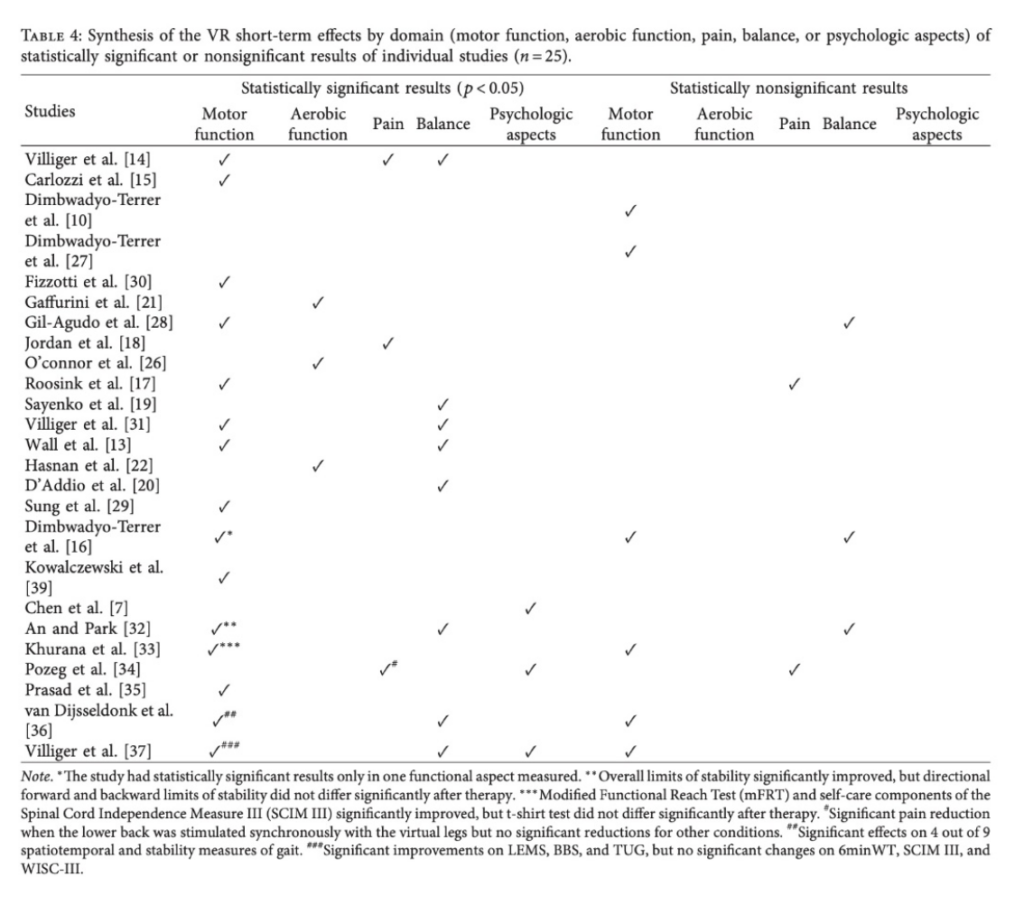
Note. From “Efficacy of Virtual Reality Rehabilitation after Spinal Cord Injury: A Systematic Review” by A. V. L. De Araújo, J. F. D. O. Neiva, C. B. D. M. Monteiro, & F. H. Magalhães, 2019, BioMed Research International, 2019(1), 7106951. (https://doi.org/10.1155/2019/7106951). Copyright © 2019 Amanda Vito ́ria Lacerda de Arau ́jo et al.
Overall, the studies did not report any negative effects due to VR therapy. In the studies that did report adverse effects, a small number of participants had a short-lived muscle pain, physical fatigue, and difficulties with attention span, and one study reported a few participants having simulator sickness.
Rating (0-5 rating scale):
3/5 This study was well done for what was possible. They found that only 7/25 studies had high quality evidence. Furthermore, the exact protocols/ VR-interventions were not provided, so it is hard to ensure the specific activities and exercises did not affect the outcomes. It would also be important to note if certain VR-based activities were more therapeutically beneficial than others.
The study states that due to this limited evidence, they recommend that VR-rehabilitation be used in conjunction with conventional therapies, and I agree based on the present findings.
More To Read

Creating an Action Plan for Addressing Mental Health in the Clinic
Blog By: Rachel Reed As hand therapists, our care for our patients must be driven by the goal of treating the whole person, not just their hand or injury (Hannah, 2011). Occupational therapy is a unique profession in which we are equipped to view our patients through a holistic lens. With this lens, we are…

Pediatric & Adolescent Shoulder Instability
Lin, K.M, James, E.W., Spitze, E. & Fabricant, P.D. (2018). Pediatric and adolescent anterior shoulder instability: Clinical management of first-time dislocators. Current opinion in pediatrics, 30, 49-56. doi: 10.1097/MOP.0000000000000566. The Skinny: Shoulder instability for pediatric and adolescent patients is fairly common and is often complicated by a high re-dislocation rate. Shoulder instability typically occurs after…
THUMB ABDUCTION IN PATIENTS WITH CMC ARTHRITIS? HOW DO YOU MEASURE?
Article Review THUMB ABDUCTION IN PATIENTS WITH CMC ARTHRITIS? HOW DO YOU MEASURE? Corey McGee PhD, OTR/L, CHT , Virginia O’Brien OTD, OTR/L, CHT , Jennifer Skye MS, OTR/L, CHT , Katherine Wall MOT, OTR/L , Thumb Carpometacarpal Palmar and CMC Radial Abduction in Adults with Thumb Carpometacarpal Joint Pain: Inter-rater Reliability and Precision of…
Distal radius fracture types seen in the hand therapy clinic
Distal radius fractures are one of the most common injuries seen in hand therapy. Several different distal radius fracture classification systems have been developed, and this blog post will focus on the more common types of distal radius fractures and their classification. Extra-articular fractures are either nondisplaced or displaced fractures. These fractures occur outside…

Sign-up to Get Updates Straight to Your Inbox!
Sign up with us and we will send you regular blog posts on everything hand therapy, notices every time we upload new videos and tutorials, along with handout, protocols, and other useful information.