

Efficacy of Virtual Reality Rehabilitation after Spinal Cord Injury: A Systematic Review
Filed under Treatments
De Araújo, A. V. L., Neiva, J. F. D. O., Monteiro, C. B. D. M., & Magalhães, F. H. (2019). Efficacy of virtual reality rehabilitation after spinal cord injury: A systematic review. BioMed Research International, 2019(1), 7106951. https://doi.org/10.1155/2019/7106951
Efficacy of Virtual Reality Rehabilitation after Spinal Cord Injury
Emilee Sanders, OTS
The Skinny:
Virtual reality (VR) rehabilitation may help individuals with spinal cord injury (SCI) improve motor function, motor skills, balance, and aerobic function and reduce pain either as a standalone intervention or in conjunction with rehabilitation therapies. This is a first systematic review of its kind concerning the effectiveness of VR and SCI in rehabilitation.

In the Weeds:
The systematic review includes 25 studies which contained randomized controlled trials, nonrandomized controlled trials, quasi experimental studies, and before and after studies.
Participant inclusion criteria: Male and Female participants aged 18-65 years with spinal cord injury (traumatic or nontraumatic) who participated in immersive or non immersive VR-based therapy.
Two reviewers extracted data based on participant characteristics, study characteristics, methodological details, VR effects, bias risk, size effects, statistical power, and limitations.
The reviewers used a p value of < 0.05 to assess whether the effects of VR-based rehabilitation were significant for the allotted category (motor function, aerobic function, pain, balance, or psychological aspects).
Bringing it home:
Studies showed a short-term improvement on motor function, aerobic performance, balance, pain, and psychological aspects. Long-term benefits were also shown for motor function, balance, and pain. Some subjective reports from participants included better mood, satisfaction improvements, and high enjoyment.
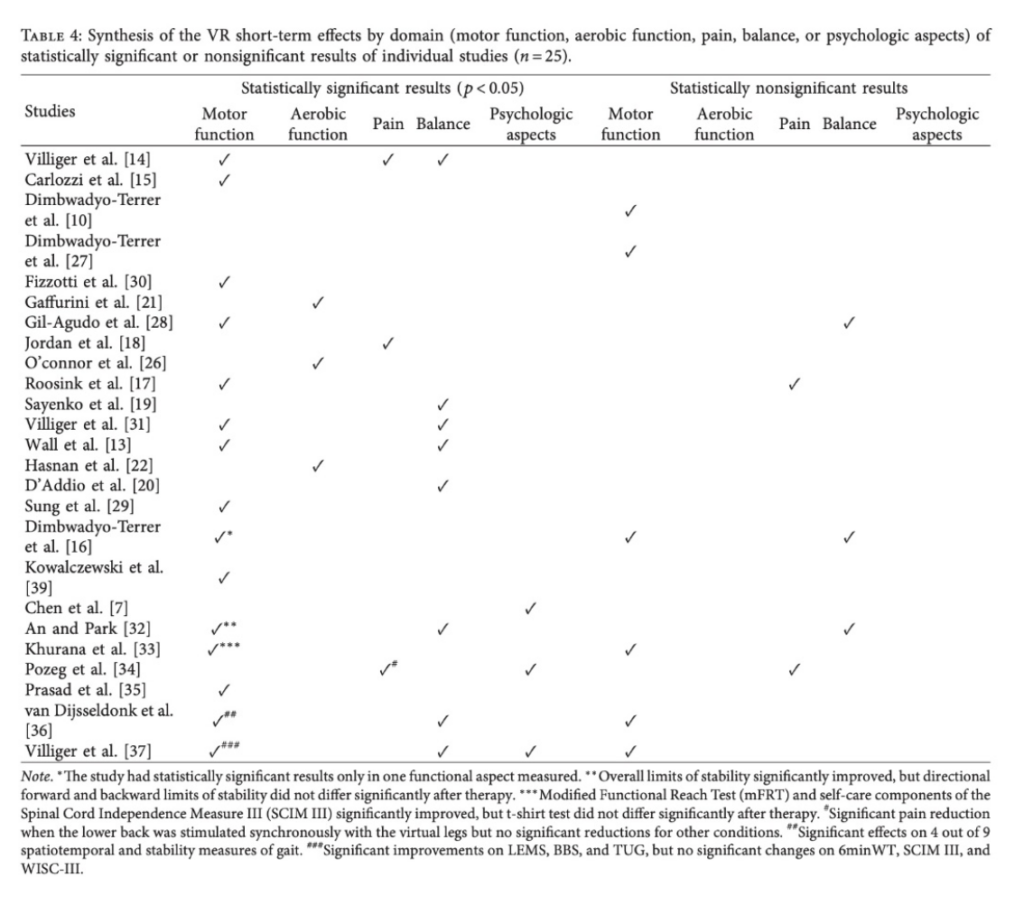
Note. From “Efficacy of Virtual Reality Rehabilitation after Spinal Cord Injury: A Systematic Review” by A. V. L. De Araújo, J. F. D. O. Neiva, C. B. D. M. Monteiro, & F. H. Magalhães, 2019, BioMed Research International, 2019(1), 7106951. (https://doi.org/10.1155/2019/7106951). Copyright © 2019 Amanda Vito ́ria Lacerda de Arau ́jo et al.
Overall, the studies did not report any negative effects due to VR therapy. In the studies that did report adverse effects, a small number of participants had a short-lived muscle pain, physical fatigue, and difficulties with attention span, and one study reported a few participants having simulator sickness.
Rating (0-5 rating scale):
3/5 This study was well done for what was possible. They found that only 7/25 studies had high quality evidence. Furthermore, the exact protocols/ VR-interventions were not provided, so it is hard to ensure the specific activities and exercises did not affect the outcomes. It would also be important to note if certain VR-based activities were more therapeutically beneficial than others.
The study states that due to this limited evidence, they recommend that VR-rehabilitation be used in conjunction with conventional therapies, and I agree based on the present findings.
More To Read
Place-and-Hold Versus Active Mobilization Therapy After Flexor Tendon Repair
Title: Passive Mobilization With Place-and-Hold Versus Active Mobilization Therapy After Flexor Tendon Repair: 5-Year Minimum Follow-Up of a Randomized Controlled Trial Article Review By: Tommi Hintnaus Reference: Chevalley, S., Wangberg, V., Ahlen, M., Stromberg, J., & Bjorkman, A. (2024, October 4). Passive Mobilization With Place-and-Hold Versus Active Mobilization Therapy After Flexor Tendon Repair: 5-Year Minimum…
Flexor tendon rehabilitation in the 21st century: A systematic review
Neiduski, R. L. & Powell, R. K. (2019). Flexor tendon rehabilitation in the 21st century: A systematic review. Journal of Hand Therapy, 32, 165-174. The Skinny The objective of the study was to determine if there was evidence to support 1 type of exercise regimen. Exercise regimens reviewed include place and holds, early passive or…

Hand Therapy Interventions for Distal Upper Extremity Injuries and Conditions
Takata, S.C., Wade, E.T., & Roll, S.C. (2019). Hand therapy interventions, outcomes, and diagnoses evaluated over the last 10 years: A mapping review linking research to practice. Journal of Hand Therapy, 32(1), 1–9. Written by Brittany Carrie The Skinny Approximately 26.9% of orthopedic injuries and disorders of the upper extremity occur worldwide. Injuries are most…
The effects of cupping therapy as a new approach in the physiotherapeutic management of carpal tunnel syndrome
Article Review By: Rachel Reed Mohammadi, S., Roostayi, M. M., Naimi, S. S., & Baghban, A. A. (2019). The effects of cupping therapy as a new approach in the physiotherapeutic management of carpal tunnel syndrome. Physiotherapy research international : the journal for researchers and clinicians in physical therapy, 24(3), e1770. https://doi.org/10.1002/pri.1770 The Skinny: The purpose of this…

Sign-up to Get Updates Straight to Your Inbox!
Sign up with us and we will send you regular blog posts on everything hand therapy, notices every time we upload new videos and tutorials, along with handout, protocols, and other useful information.