

Distal radius fracture types seen in the hand therapy clinic
Filed under Evaluation
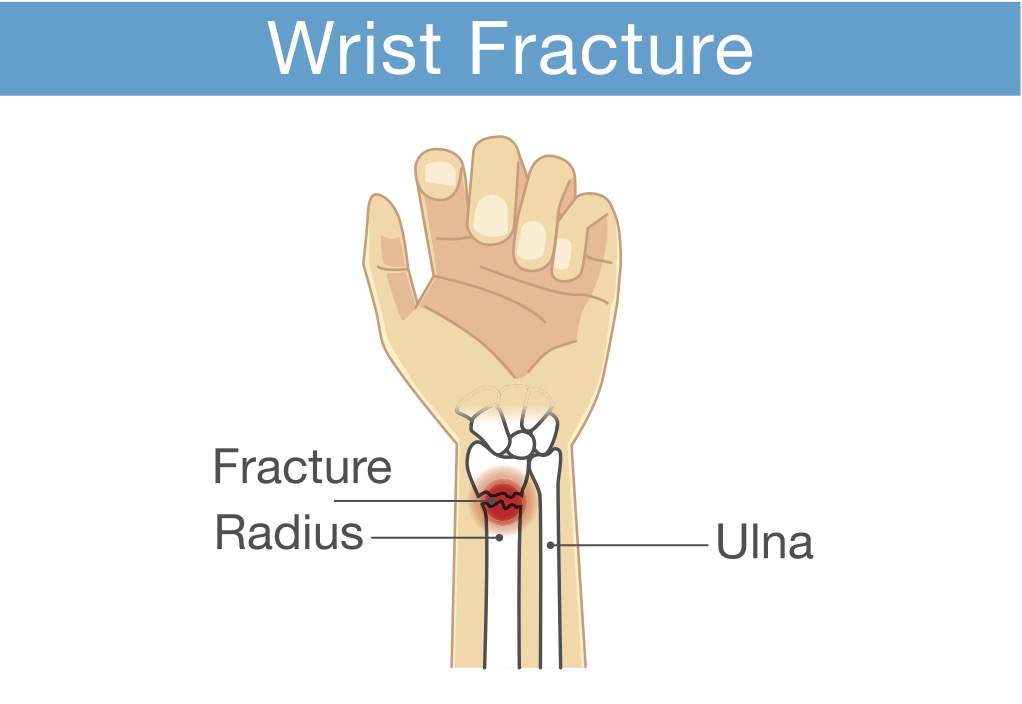
Distal radius fractures are one of the most common injuries seen in hand therapy. Several different distal radius fracture classification systems have been developed, and this blog post will focus on the more common types of distal radius fractures and their classification.
Extra-articular fractures are either nondisplaced or displaced fractures. These fractures occur outside of the joint.
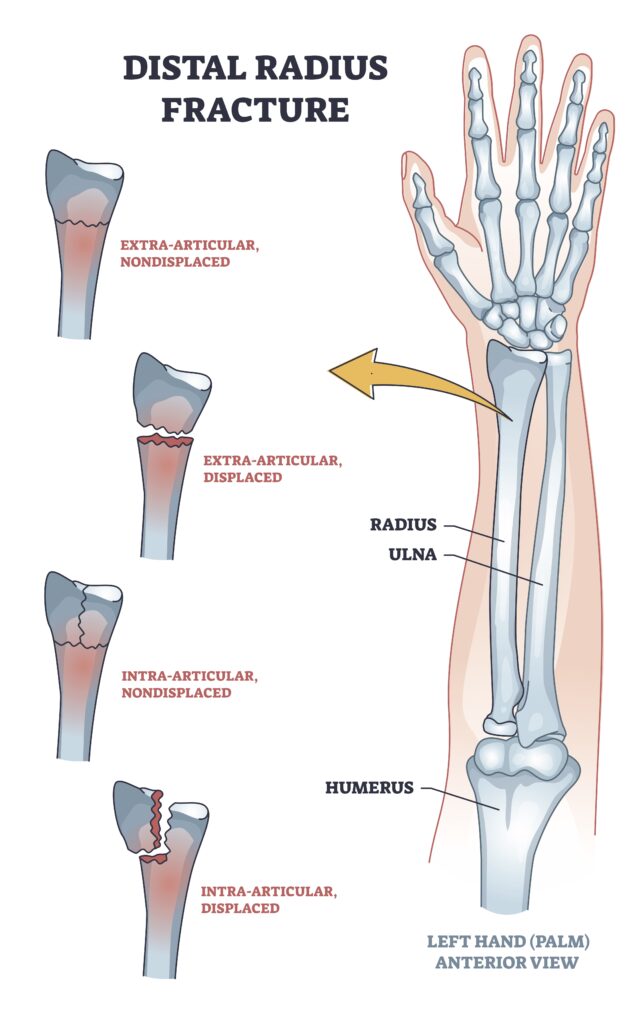
Similarly, Intra-articular fractures can be displaced or nondisplaced but occur within the joint.
Many fractures are named based on their fracture location, fracture pattern, and type of displacement.
Colles fractures are the most common type of distal radius fracture and account for about 90% of distal radius fractures. A Colles fracture is an extra-articular fracture with a dorsal displacement. These fractures occur from a fall forward on an outstretched hand.
A reverse Colles fracture is also known as Smith’s fracture. This is also an extra-articular fracture that is volarly displaced. These types of fractures are caused by falling backward and an outstretched arm.
Another type of distal radius fracture is a Barton’s fracture. This is an intra-articular fracture and is associated with a dislocation of the radio-carpal joint. A Barton’s fracture can be described as volar (more common) or dorsal (less common).
A die punch fracture is a depression fracture of the lunate fossa of the distal radius fracture that occurs with a vertical load through the lunate. These are often overlooked and not part of the classification system.
A Chauffeur’s fracture is also known as a radial styloid fracture or a Hutchinson’s fracture. This fracture is classified as an articular fracture. It was initially called a Chauffeur’s fracture because when the chauffeur would turn the crank to start the car, the motor often would cause the crank handle to jerk back.
1 Comment
Leave a Comment
More To Read
Is therapy needed after a distal radius fracture?
Coughlin T, Norrish AR, Scammell BE, Matthews PA, Nightingale J, Ollivere BJ. Comparison of rehabilitation interventions in nonoperatively treated distal radius fractures: a randomized controlled trial of effectiveness. Bone Joint J. 2021Jun;103-B(6):1033-1039. doi: 10.1302/0301-620X.103B.BJJ-2020-2026.R1.Epub 2021 Apr 30. PMID: 33926211. The Skinny: Individuals with distal radius fractures are very common in the hand therapy world. This…

Covid-19: What is your clinic doing?
It’s what every patient is talking about when they come in? With the suspension of every major sport, international travel banned, and hospital quarantines, everyone wants to know what their own therapists are doing to address the problem. I’m a small business owner and therapist. That means I really have 3 priorities. 1: Protect my…

All about kinesiology taping for upper extremity injuries and conditions!
All about kinesiology taping! Elastic is also known as k-tape, Kinesio-tape, and kinesiology taping. Elastic tape is all over the marketplace and is often seen on professional athletes. It can be found in most therapy clinics and is used to treat both orthopedic and neurological conditions. There are limited studies supporting the use of…
A Fun Fact from a Hand Therapy Student
By: Ammie Ingwaldson Level 2 Fieldwork at a hand therapy clinic is a fast paced and continuous learning experience. The perfect example of this occurred last week while observing a therapist provide a client with their home CMC arthritis program. The therapist was educating the client on how to oppose their thumb to their small…

Sign-up to Get Updates Straight to Your Inbox!
Sign up with us and we will send you regular blog posts on everything hand therapy, notices every time we upload new videos and tutorials, along with handout, protocols, and other useful information.
Thank you so much! I always enjoy your informative blogs and have learned a great deal. Your effort is very much appreciated!!!