
Handlebar Palsy also known as Ulnar Nerve Compression
Handlebar palsy, also known as ulnar nerve compression, is a condition commonly experienced by cyclists due to prolonged pressure on the ulnar nerve at the wrist in an area called Guyon’s Canal. This pressure can occur from putting pressure on the handlebars or gripping the handlebars tightly. This occurs more for long distance riders or those who ride through rough terrain. Symptoms may include numbness, tingling, and weakness in the ring and small fingers. This symptoms vary base on the site of compression within Guyon’s Canal. The condition is similar to cubital tunnel syndrome but affects the ulnar nerve at the wrist rather than the elbow.
Guyon’s Canal:
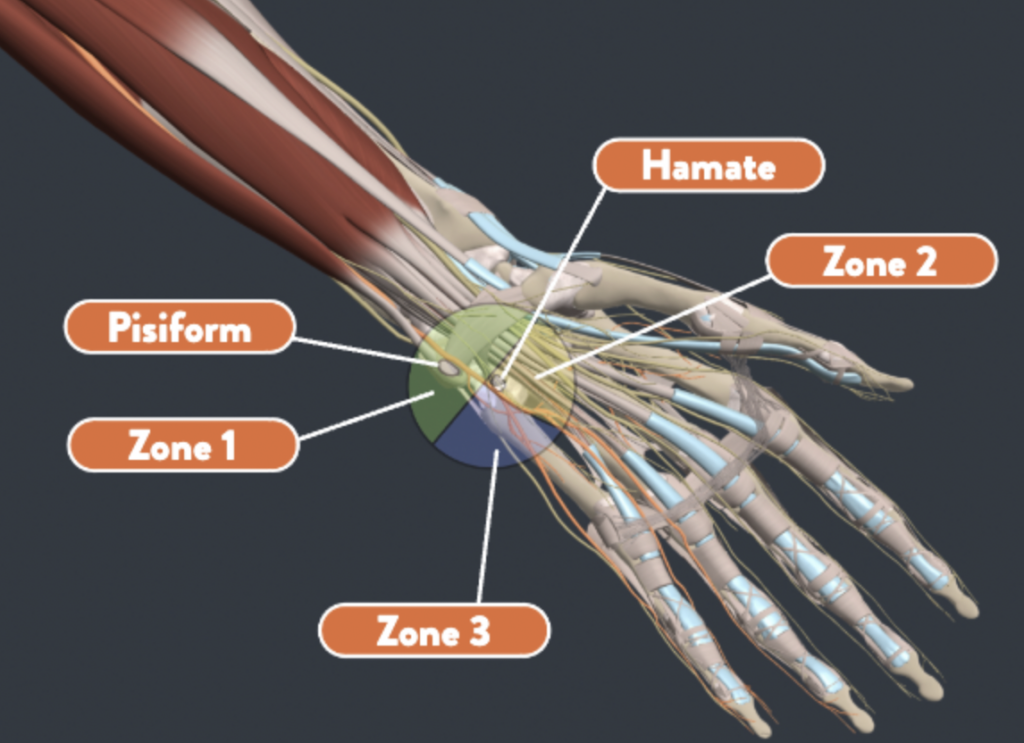
Guyon’s canal, also known as the ulnar tunnel, is a semi-rigid, fibro-osseous space located at the wrist between the pisiform and hamate bones. The ulnar nerve passes through this canal, and any compression here can lead to a condition known as Guyon’s canal syndrome, ulnar tunnel syndrome, or handlebar palsy. Guyon’s canal can be divided into three anatomical zones where the ulnar nerve and its branches can be compressed:
- Zone 1: Proximal to the bifurcation of the ulnar nerve, affecting both motor and sensory branches. Symptoms: Motor weakness in the intrinsic muscles of the hand (hypothenar muscles, interossei, adductor pollicis, and the ulnar two lumbricals), along with sensory deficits in the ring and little fingers.
- Zone 2: At the bifurcation, affecting the deep motor branch. Symptoms: Motor deficits similar to those in Zone 1 but without sensory impairment. This includes weakness in the intrinsic muscles of the hand but normal sensation in the ring and little fingers.
- Zone 3: Distal to the bifurcation, affecting the superficial sensory branch. Symptoms: Sensory deficits in the ring and little fingers without motor impairment. This results in numbness or tingling in these fingers but no muscle weakness.
Understanding these zones is crucial for diagnosing the specific location of the nerve compression and determining the appropriate treatment approach, which can range from rest and ergonomic adjustments to surgical decompression in severe cases.
Conservative Treatment for Cubital Tunnel Syndrome
- Rest and Activity Modification:
- Reduce the duration and intensity of cycling to allow the nerve to recover.
- Avoid activities that exacerbate symptoms.
- Ergonomic Adjustments:
- Adjust the handlebar position to reduce pressure on the wrists.
- Use padded handlebar grips or gloves to cushion the hands.
- Ensure proper bike fit to distribute weight evenly and reduce pressure on the wrists.
- Wrist Splints:
- Wearing a wrist splint, especially during sleep, can help keep the wrist in a neutral position and relieve pressure on the nerve.
- Therapy:
- Exercises to strengthen the hand and wrist muscles.
- Stretching exercises to improve flexibility and reduce tension on the nerve.
- Anti-inflammatory Medications:
- Nonsteroidal anti-inflammatory drugs (NSAIDs) can help reduce inflammation and alleviate pain.
- Nerve Gliding Exercises:
- Specific exercises designed to mobilize and stretch the ulnar nerve to prevent it from becoming trapped or compressed.
Medical Treatment for Cubital Tunnel Syndrome
- Corticosteroid Injections:
- In some cases, corticosteroid injections may be used to reduce inflammation around the nerve.
- Pain Management:
- Medications such as gabapentin or pregabalin may be prescribed for nerve pain.
Surgical Treatments
- Decompression Surgery:
- In severe cases where conservative treatments fail, surgery may be needed to relieve pressure on the ulnar nerve. This might involve releasing the ligament that is compressing the nerve or removing any structures causing the compression.
Preventive Measures
- Proper Bike Fit:
- Ensure your bike is properly fitted to your body to avoid unnecessary pressure on the wrists.
- Frequent Breaks:
- Take regular breaks during long rides to reduce continuous pressure on the wrists.
- Alternate Hand Positions:
- Change hand positions frequently on the handlebars to distribute pressure more evenly.
- Handlebar and Glove Padding:
- Use well-padded gloves and handlebars to reduce direct pressure on the ulnar nerve.
Addressing handlebar palsy early and making necessary adjustments can help prevent the condition from worsening and promote recovery.
More To Read
Effects of different stretching techniques for improving joint range of motion.
Reference: Oba, K., Samukawa, M., Abe, Y., Suzuki, Y., Komatsuzaki, M., Kasahara, S., Ishida, T., & Tohyama, H. (2021). Effects of Intermittent and Continuous Static Stretching on Range of Motion and Musculotendinous Viscoelastic Properties Based on a Duration-Matched Protocol. International journal of environmental research and public health, 18(20), 10632. https://doi-org.libproxy.nau.edu/10.3390/ijerph182010632 The Skinny: This study used a cross-over…
5 return-to-cooking activities (that don’t require a kitchen)
Hand therapy can and should be very occupation-based. Every week, we hear comments from patients that back that statement up: “I need to get back to work” “I just want to golf again” “I can’t even open a water bottle” “My spouse has to do all of the cooking” Although standard exercises are helpful, it’s…
3 Household Objects for 9 different Hand Therapy Activities
Do you struggle to develop new treatment ideas or even ideas for your virtual hand therapy visits? Thinking of unique ways to use objects your clients have in their homes can be half the battle. This blog post presents 3 different ways to use 3 everyday items. Item number 1: A tennis ball (hand therapy…
Hand Therapy Article Review: The Radial Synergy Test, An Aid to Diagnose de Quervain’s Tenosynovitis
Chihua, L., Langford, P.N., Sullivan, G.E., Langford, M.A., Hogan, C.J., & Ruland, R.T. (2021) The radial synergy test: an aid to diagnose de Quervain’s tenosynovitis. HAND. epub ahead of print;1-6. doi: 10.1177/15589447211057297 Rapid Review By: Case Peters The Skinny: de Quervain’s tenosynovitis is a common pathology that involves swelling and thickening of the tendon sheaths…

Sign-up to Get Updates Straight to Your Inbox!
Sign up with us and we will send you regular blog posts on everything hand therapy, notices every time we upload new videos and tutorials, along with handout, protocols, and other useful information.