

What is a Slap Tear? Superior Labrum Anterior to Posterior Tear
Filed under Diagnoses, Evaluation
What is a SLAP injury?
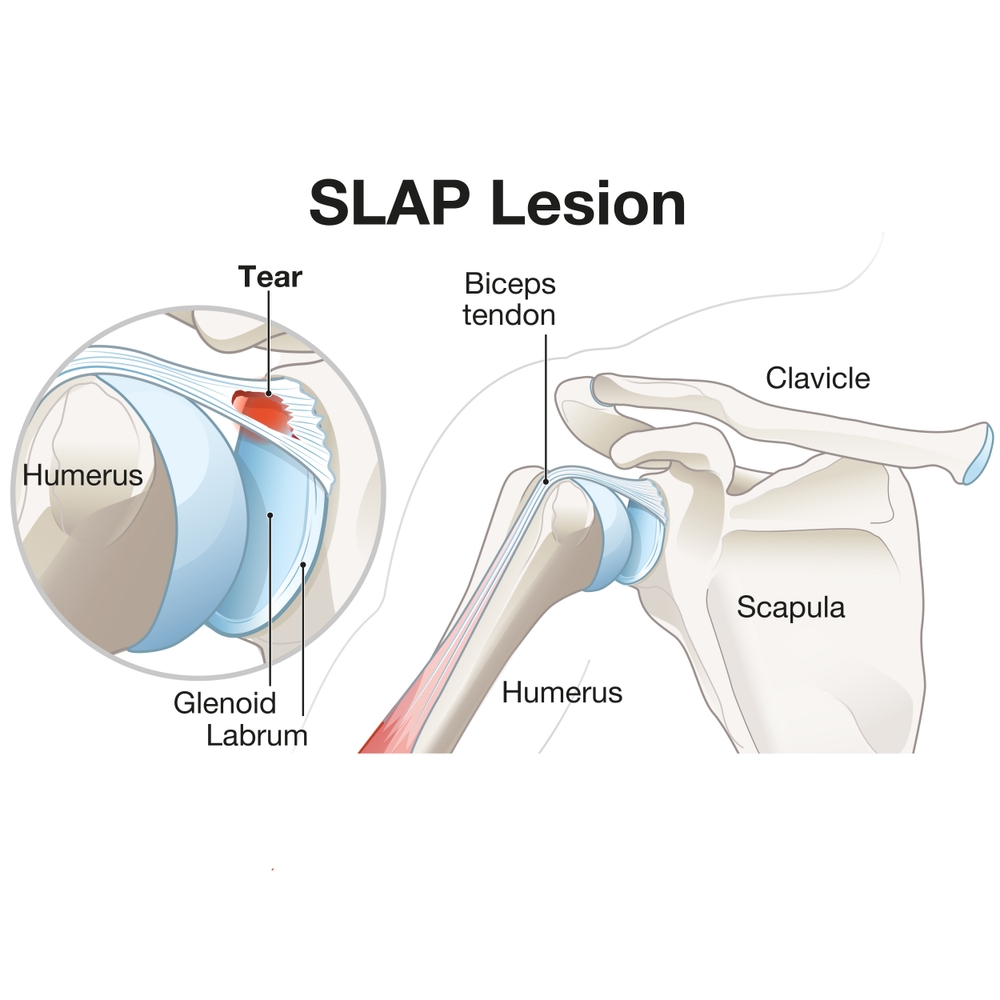
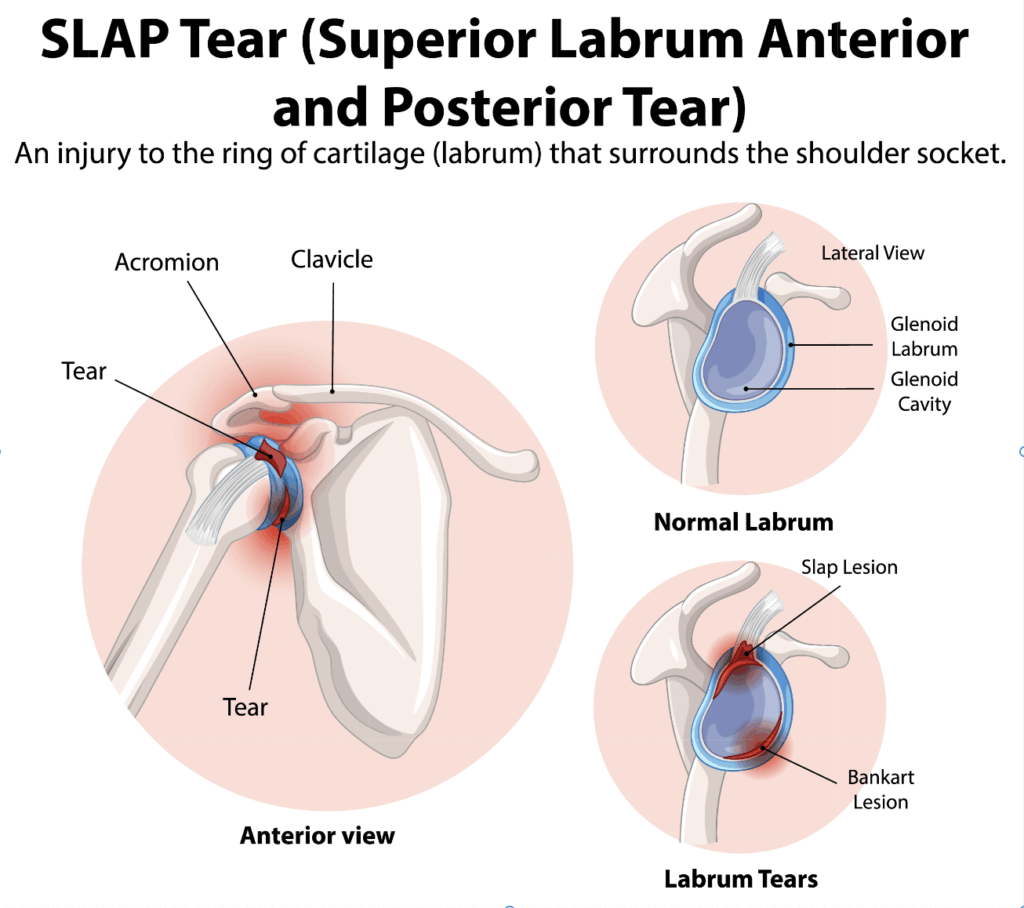
A Superior Labral, Anterior and Posterior (SLAP) lesion is an injury effecting the superior
portion of the glenoid labrum where the long head of the biceps tendon is anchored (Levasseur et
al., 2021). The tearing commonly occurs posteriorly and extends anteriorly at the mid-glenoid
notch which can be examined through shoulder arthroscopy (Kim et al., 2003). Patients will
often complain of pain with overhead movements and the feeling of shoulder instability (Knseck
et al., 2013).
Mechanism of Injury
SLAP lesion have multiple mechanisms for injury with most common being a fall on an
outstretched arm causing compressive force at the shoulder, traction at the arm, and tensile
loading of the long head of the biceps tendon (Levasseur et al., 2021). This is a common injury
with overhead throwing athletes as continuous torsional forces from the contraction of the long
head of the biceps tendon increases shearing of the posterior labrum with it tearing from back to
front (Burkhart and Morgan, 1998).
SLAP Tear Classification (Snyder et al., 1990)
- Type I: Fraying of the labrum (age-related)
- Type II: Detachment of the biceps anchor (most common)
- Type III: Bucket-handle tear without biceps involvement
- Type IV: Bucket-handle tear extending into the biceps tendon
Provocative testing options (Parentis et al., 2006)
Highest sensitvitity provacative test for SLAP Tear include:
- Hawkins
- Speed
- Neer
- Jobe Relocation
Treatment Options - Conservative management includes therapy for strengthening of scapular and rotator cuff
muscles for correction of shoulder dyskinesia (Levasseur et al., 2021). - Surgical management includes labrum and biceps tendon repair, debridement, and
tenotomy (Jang et al., 2016)
Postoperative rehabilitation
Rehabilitation after a SLAP repair should focus on protecting the repair while gradually restoring
function. Initially, the shoulder is immobilized in a sling, with gentle pendulum and isometric
deltoid exercises starting as pain decreases. To avoid stressing the repair, overhead motions and
biceps contractions are restricted for 6–12 weeks (Wilk et al., 2023). At 3 weeks, shoulder range
of motion exercises begin, followed by strengthening of the rotator cuff and scapular stabilizers
at 6 weeks. For athletes, sports-specific training starts around 3 months, with throwing
reintroduced at 4–6 months. Full return to unrestricted throwing typically occurs at 8–9 months
post-op (Wilk et al., 2023).
References
Burkhart, S. S., & Morgan, C. D. (1998). The peel-back mechanism: its role in producing and
extending posterior type II SLAP lesions and its effect on SLAP repair
rehabilitation. Arthroscopy : the journal of arthroscopic & related surgery : official publication
of the Arthroscopy Association of North America and the International Arthroscopy
Association, 14(6), 637–640.
Familiari, F., Huri, G., Simonetta, R., & McFarland, E. G. (2019). SLAP lesions: current
controversies. EFORT open reviews, 4(1), 25–32. https://doi.org/10.1302/2058-5241.4.180033
Jang, S. H., Seo, J. G., Jang, H. S., Jung, J. E., & Kim, J. G. (2016). Predictive factors associated
with failure of nonoperative treatment of superior labrum anterior-posterior tears. Journal of
shoulder and elbow surgery, 25(3), 428–434.
Kim, T. K., Queale, W. S., Cosgarea, A. J., & McFarland, E. G. (2003). Clinical features of the
different types of SLAP lesions: an analysis of one hundred and thirty-nine cases. The Journal of
bone and joint surgery. American volume, 85(1), 66–71.
Knesek, M., Skendzel, J. G., Dines, J. S., Altchek, D. W., Allen, A. A., & Bedi, A. (2013).
Diagnosis and Management of Superior Labral Anterior Posterior Tears in Throwing Athletes.
The American Journal of Sports Medicine, 41(2), 444–460.
LeVasseur, M. R., Mancini, M. R., Hawthorne, B. C., Romeo, A. A., Calvo, E., & Mazzocca, A.
D. (2021). SLAP tears and return to sport and work: current concepts. Journal of ISAKOS, 6(4),
204-211.
Parentis, M. A., Glousman, R. E., Mohr, K. S., & Yocum, L. A. (2006). An evaluation of
the provocative tests for superior labral anterior posterior lesions. The American journal
of sports medicine, 34(2), 265–268. https://doi.org/10.1177/0363546505279911
Snyder, S. J., Karzel, R. P., Del Pizzo, W., Ferkel, R. D., & Friedman, M. J. (1990). SLAP
lesions of the shoulder. Arthroscopy : the journal of arthroscopic & related surgery : official
publication of the Arthroscopy Association of North America and the International Arthroscopy
Association, 6(4), 274–279. https://doi.org/10.1016/0749-8063(90)90056-j
Wilk, K. E., Macrina, L. C., Cain, E. L., Dugas, J. R., & Andrews, J. R. (2013). The recognition
and treatment of superior labral (slap) lesions in the overhead athlete. International journal of
sports physical therapy, 8(5), 579–600.
More To Read

Carpal Tunnel Treatment: Splinting Only vs Splinting & Conservative Treatment
Short-term clinical outcome of orthosis alone vs combination of orthosis, nerve, and tendon gliding exercises and ultrasound therapy for treatment of carpal tunnel syndrome. Sim, Sze En et al. Journal of Hand Therapy, Volume 32, Issue 4, 411 – 416 The Skinny- Carpal tunnel syndrome (CTS) is the most common compression neuropathy. Compression of the…
THUMB ABDUCTION IN PATIENTS WITH CMC ARTHRITIS? HOW DO YOU MEASURE?
Article Review THUMB ABDUCTION IN PATIENTS WITH CMC ARTHRITIS? HOW DO YOU MEASURE? Corey McGee PhD, OTR/L, CHT , Virginia O’Brien OTD, OTR/L, CHT , Jennifer Skye MS, OTR/L, CHT , Katherine Wall MOT, OTR/L , Thumb Carpometacarpal Palmar and CMC Radial Abduction in Adults with Thumb Carpometacarpal Joint Pain: Inter-rater Reliability and Precision of…
Surgery & Hand Therapy Highlights for Dupuytren’s Disease
Dupuytren’s disease affects the fascia of the hand (Dupuytren’s fasciectomy hand). It is relatively common to encounter patients with Dupuytren’s condition, even if that is not the primary reason you are treating the patient. Patients often present with a nodule(s) in the palm of the hand, or they may even have a thickened cord running…
Management of the Stiff Finger: Evidence and Outcomes
Title: Management of the Stiff Finger: Evidence and Outcomes Reference: Yang, G., McGlinn, E. P., & Chung, K. C. (2014). Management of the stiff finger: Evidence and outcomes. Clinics in Plastic Surgery, 41(3), 501–512. https://doi.org/10.1016/j.cps.2014.03.011 Article Review By: Tommi Hintnaus The Skinny: This study focuses on understanding and managing finger stiffness, a condition characterized by…

Sign-up to Get Updates Straight to Your Inbox!
Sign up with us and we will send you regular blog posts on everything hand therapy, notices every time we upload new videos and tutorials, along with handout, protocols, and other useful information.