

Mechanism of injury
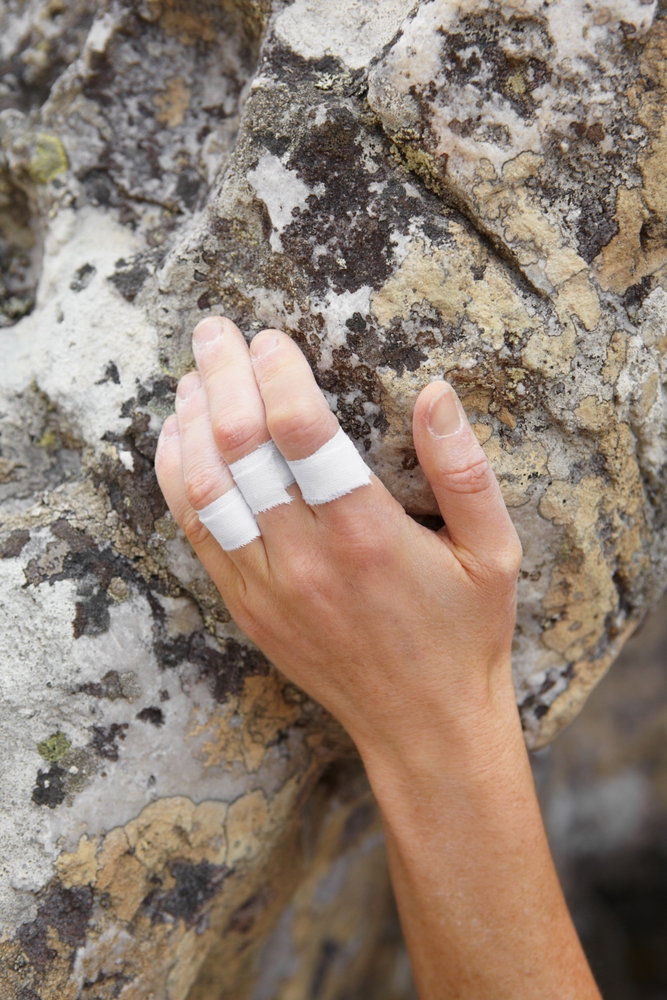
- Closed pulley ruptures and pulley injuries are an uncommon injury but are most often observed with rock climbers and boulderers. Rock climbers and boulderers apply high amounts of stress to the annular pulleys when grasping holds with their hand in the “crimp position” where the proximal interphalangeal joint (PIPJ) is at 90-100 degrees of flexion and the distal interphalangeal joint (DIPJ) is loaded into hyperextension while grasping a small hold (Schweizer, 2001). The forces loaded through the flexor digitorum profundus (FDP) tendon in the crimp position are highest at the A2 pulley making it the most injured pulley in rock climbers (Crowley, 2012). Specifically, the friction of the tendon on the pulley during eccentric loading is thought to be main cause of a closed rupture (Schöffl et al., 2009).

Grades of pulley injury
- Shoeffl’s classification of flexor pulley injuries includes the following:
- Grade 1: A sprain or partial tear of a pulley
- Grade 2: Complete rupture of the A4 or A1 pulley or partial rupture of A2 or A3
- Grade 3: Complete rupture of A2 or A3 pulley
- Grade 4: Multiple pulley rupture or single rupture with lumbrical muscle or collateral ligament involvement.
Treatment options for closed rupture
- Current evidence shows conservative management for grades 1-3 is the best option for closed pulley ruptures. Treatments for these grades may include circumferential taping at the distal end of the proximal phalanx to provide external support for the pulley (Crowley, 2012). Grade 3 pulley injuries should be immobilized for 2-4 weeks following injury with a circumferential thermoplastic ring over the injured pulley.
- Grade 4 flexor pulley injuries are treated surgically through methods of tendon grafting where the palmaris longus tendon is grafted and wrapped around the flexor tendon and phalanx (Widstrom et al., 1989). Immobilization should last 2 weeks with light functional therapy starting at 4 weeks (Bosco et al., 2022).
Outcome measures
- Parameters to assess rehab progress can include:
- Total Active Motion (TAM)
- IP joint ROM
- IP joint extensor lag
- Buck-Gramko Score
Return to climbing
- Depending on grade of injury and clinical presentation, return to light climbing can begin 6-12 weeks following an isolated A2 pulley injury (Crowley, 2012).
- Injuries with surgical repair should be assessed for return to climbing with level of tendon glide, available ROM, and pain. Climbing should not be initiated for 3+ months following surgical repair (Crowley, 2012).
Exercise considerations
- Functional climbing exercises following a closed pulley lesion can include light progressive loading through grip mediums such as hangboards. Open grips outside of the crimp position should be prioritized for early loading and progressed to low loading through crimp grips (Crowley, 2012).
- Eccentric loading exercises, tendon glides, and selecting climbing routes that don’t require crimp grip are all good options for warm up and climbing specific rehabilitation for closed pulley injuries. (Crowley, 2012)
Resources
Bollen S. R. (1990). Upper limb injuries in elite rock climbers. Journal of the Royal College of Surgeons of Edinburgh, 35(6 Suppl), S18–S20.
Bosco, F., Giustra, F., Lusso, A., Faccenda, C., Artiaco, S., & Massè, A. (2022). Closed flexor pulley injuries: A literature review and current practice. Journal of orthopaedics, 34, 246–249. https://doi.org/10.1016/j.jor.2022.09.002
Crowley T. P. (2012). The flexor tendon pulley system and rock climbing. Journal of hand and microsurgery, 4(1), 25–29. https://doi.org/10.1007/s12593-012-0061-3
Schweizer A. (2001). Biomechanical properties of the crimp grip position in rock climbers. Journal of biomechanics, 34(2), 217–223. https://doi.org/10.1016/s0021-9290(00)00184-6
Schöffl, I., Oppelt, K., Jüngert, J., Schweizer, A., Bayer, T., Neuhuber, W., & Schöffl, V. (2009). The influence of concentric and eccentric loading on the finger pulley system. Journal of biomechanics, 42(13), 2124–2128. https://doi.org/10.1016/j.jbiomech.2009.05.033
Widstrom, C. J., Johnson, G., Doyle, J. R., Manske, P. R., & Inhofe, P. (1989). A mechanical study of six digital pulley reconstruction techniques: Part I. Mechanical effectiveness. The Journal of hand surgery, 14(5), 821–825. https://doi.org/10.1016/s0363-5023(89)80082-6
More To Read

Hand Pain in Pregnancy and the New Parent
By: Rachel Reed The transition to parenting can be difficult on a mother or parent’s body, especially when considering the increase in repetitive hand use required to care for a baby. The most common upper extremity conditions that develop during pregnancy and postpartum are carpal tunnel syndrome and de Quervain’s tenosynovitis (Wagner, 2019). Frequently, new…
What is the Effectiveness of IASTM?
Citation Kim, J., Sung, D. J., Lee, J. (2017). Therapeutic effectiveness of instrument-assisted soft tissue mobilization for soft tissue injury: Mechanisms and practical application. Journal of Exercise Rehabilitation, 13(1). doi: https://doi.org/10.12965/jer.1732824.412 The skinny IASTM is a relatively simple technique that uses the surface of an instrument to minimize the amount of pressure or force needed…
Wound Healing Complications in Diabetic Patients who have undergone a Carpal Tunnel or Trigger Finger Release
By: Amalia Garcia Gundlach, B. K., Robbins, C. B., Lawton, J. N., & Lien, J. R. (2021). Wound Healing Complications in Diabetic Patients Undergoing Carpal Tunnel and Trigger Finger Releases: A Retrospective Cohort Study. The Journal of Hand Surgery, S0363502321003014. https://doi.org/10.1016/j.jhsa.2021.05.009 The Skinny – carpal tunnel and diabetes In general, individuals with diabetes are more…
Hand Therapy as a New Grad or Student
Tips for Getting Prepared for hand therapy as a new grad or a Level II Fieldwork Everything you need to know in hand therapy starts with the upper extremity anatomy. Here is a quick checklist to review and hopefully help get you started in your new hand therapy setting. By: Tristany Hightower I suggest, as…

Sign-up to Get Updates Straight to Your Inbox!
Sign up with us and we will send you regular blog posts on everything hand therapy, notices every time we upload new videos and tutorials, along with handout, protocols, and other useful information.