

Rotator Cuff Pain: K Tape + Rehab Short-Term Effects
Classé sous Traitements
Nguyen, T. N. A., Nguyen, N. H., Vu, D. K., & Cu, L. T. N. (2025). Short-term effects of
Kinesiotaping combined with a rehabilitation program for rotator cuff-related shoulder pain: A
randomized, assessor-blinded clinical trial. Journal of Manual & Manipulative Therapy, 33(2),
112–121. https://doi.org/10.1080/10669817.2024.2387913
Le maigre :
The term coiffe des rotateurs related shoulder pain (RCRSP) encompasses a range of disorders
associated with coiffe des rotateurs pathology, including coiffe des rotateurs tendinopathy, subacromial pain
syndrome, and atraumatic partial coiffe des rotateurs tear. RCRSP is present in approximately half of
patients with shoulder issues and is characterized by pain and limited arm range of motion
(ROM). RCRSP is typically treated with a combination of patient education, manual therapy,
exercise, electrotherapy, and, in some cases, surgery. K taping (KT) is an elastic and
adhesive tape thought to provide pain relief, improve lymphatic and vascular function, and
support injured muscles and joints. This study examined the clinical efficacy of K taping in
conjunction with a rehabilitation program for RCRSP.
Dans les mauvaises herbes :
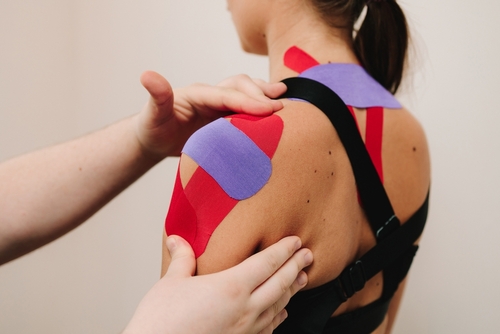
The single-blinded randomized controlled trial included two groups, a control group and a k taping
group, each with 40 participants. Both groups completed a 2-week shoulder rehabilitation
program comprising 10 sessions, each lasting 45 to 60 minutes. Both groups underwent infrared
therapy, ultrason, and progressive shoulder strengthening. The only difference between groups
was that the k tape group received three strips of K-tape to the affected shoulder and was
instructed to leave the tape on for 72 hours or until the next session.
Le ramener à la maison :
Both groups benefited from the shoulder rehabilitation program, demonstrating decreased
shoulder pain and increased function; however, greater benefits were observed in the KT group.
At 14 days postintervention, the KT group showed significantly reduced pain compared with the
control group. Additionally, the KT group gained more shoulder flexion and external rotation
ROM. By day 14, the KT group gained an average of 11.8 degrees of shoulder flexion ROM and
6.98 degrees of shoulder external rotation, both greater than those of the control group. No
significant differences were observed between groups for shoulder abduction and internal
rotation. The KT group experienced significantly improved pain immediately after KT application compared with the control group. It is presumed that KT may improve short-term
pain reduction when using the Visual Analog Scale. The study results indicate that KT may
accelerate ROM improvements in patients with RCRSP.
Note : 4/5
This study included a rigorous methodology section and accurately used statistical analyses to
interpret results. Of note, 73% of participants were male, which may limit generalizability.
Additionally, the follow-up period was short, limiting the ability to examine the differences in
long-term outcomes. In the context of hand therapy practice, KT may be valuable to trial for
patients with RCRSP for pain reduction as well as increased function and ROM.
2 commentaires
Laissez un commentaire
Plus à lire
Comment utiliser la traduction pour améliorer la motricité fine après une blessure à la main :
Je suis toujours à la recherche de nouvelles idées thérapeutiques. Je veux que mes patients restent intéressés et engagés dans la thérapie. Je veux également que les choses restent fonctionnelles et orientées vers les tâches. Une grande partie de ce que nous faisons avec nos mains concerne la coordination motrice fine et la dextérité, et c'est si difficile à reproduire en clinique.…

Moyens d'améliorer l'observance HEP dans la thérapie de la main
Moyens d'améliorer l'observance du HEP dans la thérapie de la main Par : Dalton Busch L'un des moyens les plus importants pour observer les progrès de nos patients est de s'assurer qu'ils se conforment à leur programme d'exercices à domicile (HEP) prescrit. Nos patients sont toujours encouragés à adhérer au programme prescrit, mais le respect est plus facile à dire qu'à faire. Rappel aux patients…
6 de nos outils d'équipement adaptatifs préférés pour l'arthrose CMC
Les personnes souffrant d’arthrose de la 1ère articulation CMC ont généralement des difficultés dans leurs activités quotidiennes et cela peut devenir très frustrant. Les tâches quotidiennes telles que couper des aliments, ouvrir des récipients et enfiler une chemise boutonnée peuvent devenir douloureuses et lentes. Le pouce contribue le plus à la fonction globale de notre main. Si la…
Top 5 des exercices de flexion DIP
Par : Tori Rhodes Dernièrement, nous avons eu une poignée de patients qui traversaient notre clinique avec des limitations assez importantes à la flexion DIP. Nous avons donc rassemblé une sélection d’exercices incontournables pour ces personnes. Nous en avons inclus quelques-uns ici. Des morsures de chat et des sites de fracture aux doigts de maillet et aux greffes de peau, de nombreuses personnes qui sont…

Inscrivez-vous pour recevoir des mises à jour directement dans votre boîte de réception !
Inscrivez-vous avec nous et nous vous enverrons régulièrement des articles de blog sur tout ce qui concerne la thérapie des mains, des notifications chaque fois que nous mettons en ligne de nouvelles vidéos et tutoriels, ainsi que des documents, des protocoles et d'autres informations utiles.
Great review, just the information I was looking for!
Thank you! We are glad it was helpful