

Nguyen, T. N. A., Nguyen, N. H., Vu, D. K., & Cu, L. T. N. (2025). Short-term effects of
Kinesiotaping combined with a rehabilitation program for rotator cuff-related shoulder pain: A
randomized, assessor-blinded clinical trial. Journal of Manual & Manipulative Therapy, 33(2),
112–121. https://doi.org/10.1080/10669817.2024.2387913
El delgado:
The term manguito rotador related shoulder pain (RCRSP) encompasses a range of disorders
associated with manguito rotador pathology, including manguito rotador tendinopathy, subacromial pain
syndrome, and atraumatic partial manguito rotador tear. RCRSP is present in approximately half of
patients with shoulder issues and is characterized by pain and limited arm range of motion
(ROM). RCRSP is typically treated with a combination of patient education, manual therapy,
exercise, electrotherapy, and, in some cases, surgery. K taping (KT) is an elastic and
adhesive tape thought to provide pain relief, improve lymphatic and vascular function, and
support injured muscles and joints. This study examined the clinical efficacy of K taping in
conjunction with a rehabilitation program for RCRSP.
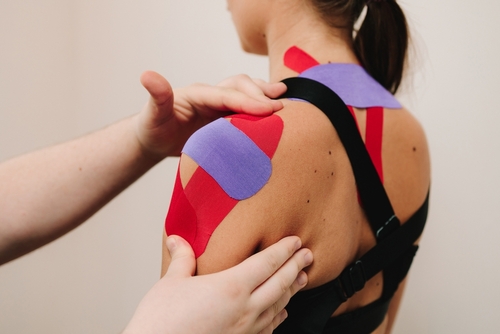
En la maleza:
The single-blinded randomized controlled trial included two groups, a control group and a k taping
group, each with 40 participants. Both groups completed a 2-week shoulder rehabilitation
program comprising 10 sessions, each lasting 45 to 60 minutes. Both groups underwent infrared
therapy, ultrasonido, and progressive shoulder strengthening. The only difference between groups
was that the k tape group received three strips of K-tape to the affected shoulder and was
instructed to leave the tape on for 72 hours or until the next session.
Llévalo a casa:
Both groups benefited from the shoulder rehabilitation program, demonstrating decreased
shoulder pain and increased function; however, greater benefits were observed in the KT group.
At 14 days postintervention, the KT group showed significantly reduced pain compared with the
control group. Additionally, the KT group gained more shoulder flexion and external rotation
ROM. By day 14, the KT group gained an average of 11.8 degrees of shoulder flexion ROM and
6.98 degrees of shoulder external rotation, both greater than those of the control group. No
significant differences were observed between groups for shoulder abduction and internal
rotation. The KT group experienced significantly improved pain immediately after KT application compared with the control group. It is presumed that KT may improve short-term
pain reduction when using the Visual Analog Scale. The study results indicate that KT may
accelerate ROM improvements in patients with RCRSP.
Calificación: 4/5
This study included a rigorous methodology section and accurately used statistical analyses to
interpret results. Of note, 73% of participants were male, which may limit generalizability.
Additionally, the follow-up period was short, limiting the ability to examine the differences in
long-term outcomes. In the context of hand therapy practice, KT may be valuable to trial for
patients with RCRSP for pain reduction as well as increased function and ROM.
Comentarios sobre 2
Deja un comentario
Más para leer

El estiramiento solo puede cambiar la forma del hueso P1 en pacientes con camptodactilia
Woo Hong, S. Kim, J., Sang Kwon, O., Ho Lee, M., Sik Gong, H., Hyun Baek, G., (2019). Remodelación radiográfica de la cabeza de la falange proximal mediante un ejercicio de estiramiento en pacientes con camptodactilia. J Hand Surg Am, 1.e1-1.e10 The Skinny - La camptodactilia es una contractura en flexión congénita y no traumática de la PIP en dedos distintos de...
Diferenciar el atrapamiento del nervio mediano proximal del síndrome del túnel carpiano
Por: Brittany Day ¿Atrapamiento del nervio mediano proximal, síndrome del pronador o síndrome de Lacertus? El síndrome de pronador es un término utilizado para describir el atrapamiento del nervio mediano proximal (PMNE) en el antebrazo. El síndrome de pronador y el síndrome de lacertus a veces se usan indistintamente para describir el atrapamiento del nervio mediano proximal, distal al ligamento de Struthers y proximal al flexor superficial...
Protocolo de entablillado y estiramiento para pulgar en gatillo pediátrico
Tan, AC, Lam, KS y Lee, EH (2002). El resultado del tratamiento del pulgar en gatillo en niños. Revista de ortopedia pediátrica B, 11(3), 256-259. The Skinny: El pulgar en gatillo pediátrico es una afección “relativamente poco común” de origen desconocido. Los estudios han indicado que la recuperación espontánea del pulgar en gatillo es de alrededor de 25-40%, y las posibilidades aumentan con la edad.…

Dolor del miembro fantasma, dolor del miembro residual y sensación del miembro fantasma: ¿cuál es cuál?
Escrito por Melissa Miller Introducción Después de la amputación, la mayoría de las personas experimentarán dolor de miembro fantasma (PLP), dolor de miembro residual (RLP) y/o sensación de miembro fantasma (PLS). Experimentar estos dolores o sensaciones puede alterar en gran medida la calidad de vida de un individuo. Es importante saber cuáles son cada uno de estos, ya que cada uno puede impactar al cliente...

¡Regístrese para recibir actualizaciones directamente en su bandeja de entrada!
Regístrese con nosotros y le enviaremos publicaciones periódicas en el blog sobre todo lo relacionado con la terapia de manos, avisos cada vez que subamos nuevos videos y tutoriales, junto con folletos, protocolos y otra información útil.
Great review, just the information I was looking for!
Thank you! We are glad it was helpful