

Rotator Cuff Pain: K Tape + Rehab Short-Term Effects
abgelegt unter Behandlungen
Nguyen, T. N. A., Nguyen, N. H., Vu, D. K., & Cu, L. T. N. (2025). Short-term effects of
Kinesiotaping combined with a rehabilitation program for rotator cuff-related shoulder pain: A
randomized, assessor-blinded clinical trial. Journal of Manual & Manipulative Therapy, 33(2),
112–121. https://doi.org/10.1080/10669817.2024.2387913
Die Dünne:
The term Rotatorenmanschette related shoulder pain (RCRSP) encompasses a range of disorders
associated with Rotatorenmanschette pathology, including Rotatorenmanschette tendinopathy, subacromial pain
syndrome, and atraumatic partial Rotatorenmanschette tear. RCRSP is present in approximately half of
patients with shoulder issues and is characterized by pain and limited arm range of motion
(ROM). RCRSP is typically treated with a combination of patient education, manual therapy,
exercise, electrotherapy, and, in some cases, surgery. K taping (KT) is an elastic and
adhesive tape thought to provide pain relief, improve lymphatic and vascular function, and
support injured muscles and joints. This study examined the clinical efficacy of K taping in
conjunction with a rehabilitation program for RCRSP.
Im Unkraut:
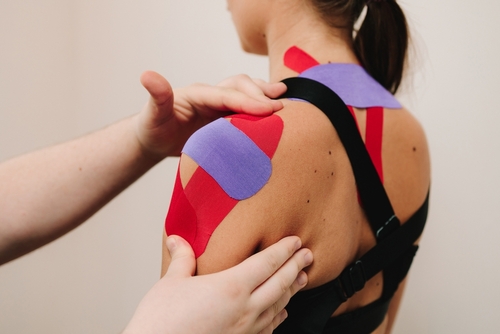
The single-blinded randomized controlled trial included two groups, a control group and a k taping
group, each with 40 participants. Both groups completed a 2-week shoulder rehabilitation
program comprising 10 sessions, each lasting 45 to 60 minutes. Both groups underwent infrared
therapy, Ultraschall, and progressive shoulder strengthening. The only difference between groups
was that the k tape group received three strips of K-tape to the affected shoulder and was
instructed to leave the tape on for 72 hours or until the next session.
Nach Hause bringen:
Both groups benefited from the shoulder rehabilitation program, demonstrating decreased
shoulder pain and increased function; however, greater benefits were observed in the KT group.
At 14 days postintervention, the KT group showed significantly reduced pain compared with the
control group. Additionally, the KT group gained more shoulder flexion and external rotation
ROM. By day 14, the KT group gained an average of 11.8 degrees of shoulder flexion ROM and
6.98 degrees of shoulder external rotation, both greater than those of the control group. No
significant differences were observed between groups for shoulder abduction and internal
rotation. The KT group experienced significantly improved pain immediately after KT application compared with the control group. It is presumed that KT may improve short-term
pain reduction when using the Visual Analog Scale. The study results indicate that KT may
accelerate ROM improvements in patients with RCRSP.
Bewertung: 4/5
This study included a rigorous methodology section and accurately used statistical analyses to
interpret results. Of note, 73% of participants were male, which may limit generalizability.
Additionally, the follow-up period was short, limiting the ability to examine the differences in
long-term outcomes. In the context of hand therapy practice, KT may be valuable to trial for
patients with RCRSP for pain reduction as well as increased function and ROM.
2 Kommentare
Hinterlassen Sie einen Kommentar
Mehr zum Lesen

Hand Contractures from Arthrogryposis Multiplex Congenita
What is Arthrogryposis Multiplex Congenita?Arthrogryposis Multiplex Congenita (AMC) is a rare congenital condition that is characterized byan individual being born with multiple joint contractures, involving two or more areas of the body(Khurana et al., 2024). AMC is a general term that describes over 400 different medicalconditions that involve joint contractures, instead of just describing one…

Hast du Wunden? Wie man als Handtherapeut mit ihnen umgeht.
Wundversorgung ist chaotisch. Es kann einschüchternd und beängstigend sein, da es so viele Arten von Wunden gibt (z. B. weiße Haut um Wunden herum) und es so viele Produkte gibt, dass es schwer ist zu wissen, was man wann und wie man es verwendet. Wenn Sie zu einer Wundversorgungskonferenz gehen, verbringen Sie die meiste Zeit...
Eine Bewertung des Bewegungsumfangs von Handgelenk und Unterarm bei gezielten Aktivitäten und Übungen bei Frakturen des distalen Radius
Eine Bewertung der Handgelenk- und Unterarmbewegung bei zielgerichteten Aktivitäten und einer Reihe von Bewegungsübungen nach der chirurgischen Reparatur einer Fraktur des distalen Radius: Eine randomisierte Crossover-Studie Collis, J., Mayland, E., Wright-St Clair, V., Rashid, U. , Kayes, N., & Signal, N. 2022. Eine Bewertung der Handgelenk- und Unterarmbewegung bei gezielten Aktivitäten und der Reichweite von…

Wann sollten Sie eine statische progressive Schiene in der Handtherapie verwenden?
Blumen, K. (2002). Eine vorgeschlagene Entscheidungshierarchie für die Schienung des steifen Gelenks mit Schwerpunkt auf Kraftanwendungsparametern. Journal of Hand Therapy, 15, 158–162. The Skinny – Der Artikel schlägt eine Entscheidungshierarchie vor, um zu bestimmen, wann Sie eine statische progressive oder dynamische Orthese verwenden sollten. Die Entscheidungshierarchie verwendet einen modifizierten Wochentest (MWT). Der…

Melden Sie sich an, um Updates direkt in Ihren Posteingang zu erhalten!
Melden Sie sich bei uns an und wir senden Ihnen regelmäßig Blogbeiträge zum Thema Handtherapie, Benachrichtigungen jedes Mal, wenn wir neue Videos und Tutorials hochladen, zusammen mit Handzetteln, Protokollen und anderen nützlichen Informationen.
Great review, just the information I was looking for!
Thank you! We are glad it was helpful