
Carpal Tunnel Syndrome Treatment: Surgical vs. Hand Therapy Outcomes
Classé sous Traitements
Carpal Tunnel Syndrome Treatment: Surgical vs. Non-Surgical Outcomes
Verdugo, R. J., Salinas, R. S., Castillo, J. L., & Cea, J. G. (2008). Surgical versus non-surgical treatment for tunnel carpien syndrome. Cochrane Database of Systematic Reviews, (4).
Le maigre
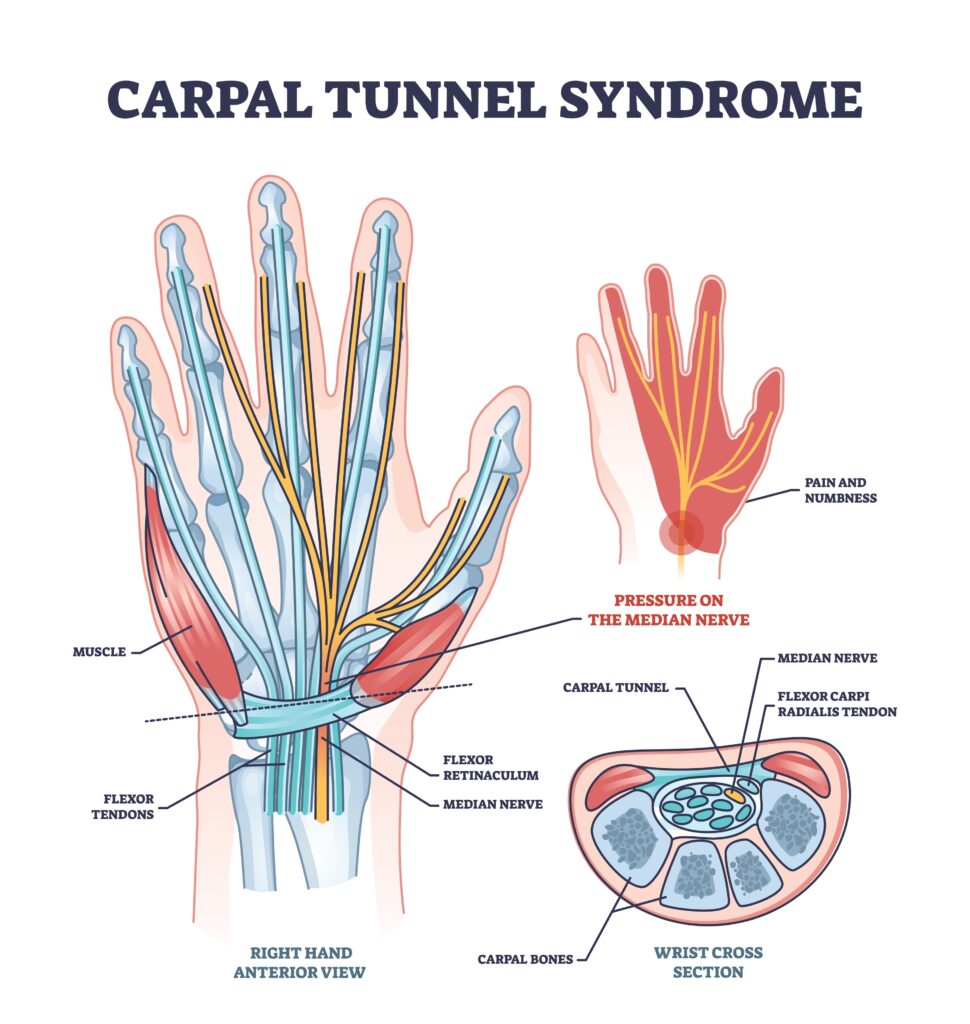
This article compares surgical treatment to non-surgical management such as thérapie de la main for individuals with tunnel carpien syndrome (CTS). Non-surgical interventions included wrist attelle, corticosteroid injections, and therapy-based approaches. The findings suggest that surgery generally provides greater symptom relief and functional improvement over time, particularly in more advanced cases. However, conservative traitement remains effective for many patients, especially those with mild to moderate symptoms.
Dans les mauvaises herbes
This study is a systematic review of randomized controlled trials comparing surgical and non-surgical treatments for CTS. Adult participants diagnosed with CTS were included, and outcomes such as pain, symptom severity, and functional hand use were evaluated.
Non-surgical interventions varied across studies but commonly included wrist splinting in a neutral position, corticosteroid injections, and therapy-based interventions. The included studies also had varying follow-up periods, allowing researchers to compare both short-term and long-term outcomes. One limitation noted was the variability in how conservative treatments were applied, making direct comparisons more difficult.
The results showed that surgical treatment generally led to greater improvement in symptoms and functional outcomes at long-term follow-up. Patients who underwent surgery experienced more consistent and sustained relief compared to those receiving conservative care.
At the same time, non-surgical interventions were still beneficial, particularly in the short term. Many patients with mild to moderate CTS demonstrated improvement with splinting and therapy-based approaches. The effectiveness of conservative treatment appeared to be more limited in patients with more severe symptoms.
Le ramener à la maison
The findings support a stepwise approach to managing tunnel carpien syndrome. Conservative treatment should typically be the first line of care, especially for patients with less severe symptoms. If symptoms persist or worsen, surgical intervention may provide greater long-term benefit.
From a clinical perspective, therapy plays an important role not only in early management but also following surgical intervention. Post-operative rehabilitation is often necessary to restore range of motion, manage scar tissue, and improve strength and functional use of the hand.
Note : 4/5
This study supports the use of a stepwise treatment approach for tunnel carpien syndrome. Conservative management remains an appropriate first option for many patients because it can reduce symptoms without requiring surgery. However, surgery appears to provide better long-term improvement when symptoms persist or become more severe.
The article was helpful because it compared both treatment approaches while also recognizing the value of therapy throughout the rehabilitation process. One limitation is that the conservative treatments varied between studies, which made some comparisons less consistent.
Plus à lire
Piégeage du nerf scapulaire dorsal et douleur thoracique
N'oubliez pas d'évaluer le piégeage du nerf scapulaire dorsal Par Delaney Wright Si votre patient présente une douleur thoracique supérieure, il est essentiel de prendre des mesures pour évaluer le piégeage du nerf scapulaire dorsal. Dans une étude réalisée par Sultan et al. (2013), 55 patients souffrant de douleurs interscapulaires ont été évalués cliniquement et par conduction nerveuse…

Efficacité de la rééducation par réalité virtuelle après une lésion de la moelle épinière : une revue systématique
De Araújo, AVL, Neiva, JFDO, Monteiro, CBDM, & Magalhães, FH (2019). Efficacité de la rééducation par réalité virtuelle après une lésion de la moelle épinière : une revue systématique. BioMed Research International, 2019(1), 7106951. https://doi.org/10.1155/2019/7106951 Efficacité de la rééducation par réalité virtuelle après une lésion de la moelle épinière Emilee Sanders, OTS Le maigre : La réalité virtuelle (RV)…

7 conseils pour aider vos patients à gérer l'arthrose de la main
Introduction L'arthrose des mains peut être frustrante et invalidante. Maladie dégénérative des articulations, elle provoque raideurs, douleurs, gonflements et diminution de la force de préhension, rendant les tâches quotidiennes comme écrire, ouvrir des bocaux et taper à la machine épuisantes. Heureusement, il existe une approche holistique éprouvée, centrée sur la thérapie de la main pour les mains arthritiques. Elle comprend des exercices sur mesure, des attelles ciblées,…
5+ attelles de doigt en maillet courantes
Les orthèses de doigt peuvent être résistantes, et l’orthèse de doigt en maillet ne fait pas exception. Le protocole d'extension DIP à 15 degrés avec les doigts en maillet est délicat à gérer lors de la fabrication d'une attelle. Les petites attelles sur les petits doigts sont également difficiles à dimensionner correctement et à utiliser des sangles aux bons endroits. Demandez à n’importe quel expérimenté…

Inscrivez-vous pour recevoir des mises à jour directement dans votre boîte de réception !
Inscrivez-vous avec nous et nous vous enverrons régulièrement des articles de blog sur tout ce qui concerne la thérapie des mains, des notifications chaque fois que nous mettons en ligne de nouvelles vidéos et tutoriels, ainsi que des documents, des protocoles et d'autres informations utiles.