

Phantom Limb Pain, Residual Limb Pain, & Phantom Limb Sensation: Which is Which?
Filed under Treatments
Written by Melissa Miller
Introduction
After amputation, the majority of individuals will experience phantom limb pain (PLP), residual limb pain (RLP), and/or phantom limb sensation (PLS). Experiencing these pains or sensations can greatly disrupt an individual’s quality of life. It is important to know what each of these are as each can impact the client differently and can be approached differently. The following will discuss what PLP, RLP, and PLS are, as well as symptoms experienced, and treatment methods.
Phantom Limb Pain (PLP)
Definition: experiencing pain in the part of the limb that has been amputated [1].
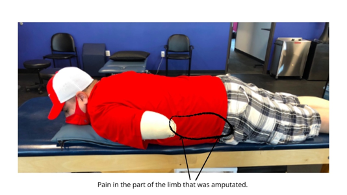
Individuals who are experiencing PLP may endure feelings of:
- Tingling
- Stabbing
- Burning
- Shooting
- Throbbing
- Aching
- Pinching
- Squeezing/clamping
PLP can be experienced as continuous pain or it may also be experienced in episodes. These episodes may last minutes to hours. PLP episodes can be triggered by a range of stimuli. Individuals may be triggered by stimuli such as touch, exposure to different temperatures, smoking, urination/defecation, etc. [2] Research has not identified one superior approach to treat all PLP, different approaches have been found to work for different people. Some common treatment approaches that have good evidence include: [3,4]
- Mirror Therapy
- Virtual Reality
- Biofeedback
- TENS
- Acupuncture
- Massage of residual limb
PLP can severely impact an individual’s quality of life. As a practitioner you can help your client to identify what triggers their PLP and help them to avoid or understand when those triggers may occur, as well as experiment to find what treatment approach reduces their pain most effectively.
Residual Limb Pain (RLP)
Definition: experiencing pain in the remaining part of the limb that was not amputated. [1]
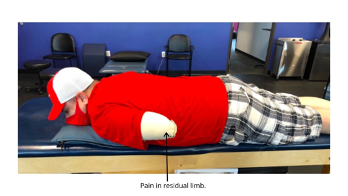
Residual limb pain, or otherwise known as stump pain can occur for different reasons. Some common causes of residual limb pain include: [6]
- Underlying disease process (ex. diabetes)
- Trauma from surgery
- Neuromas (bundle of nerves at the end of the stump)
- Entrapment of nerves in scar tissue
- Skin infection
- Pressure points with or without skin breakdown
- Complex regional pain syndrome (CRPS)
- Phantom limb pain
In order to treat RLP, you first need to know where that pain is originating from. This may be a process of elimination if the reason for pain is not something as obvious as an oozing skin infection. For example, you may have a client who has diabetes, and since the amputation they be having a difficult time managing their blood sugar levels. This can have adverse effects on the healing process, causing the patient additional pain in the residual limb. In this case, you could start treatment of RLP with focusing on getting their underlying condition of diabetes under control. Depending on the root of the pain, you are going to treat each client individually for their case. Treatment approaches that may be appropriate for RLP include:
- Wound management
- Edema management
- Infection management
- Massage
- Light tapping with elevation
- Light exercise
- Desensitization
- Medication management
Phantom Limb Sensation (PLS)
Phantom pain definition: experiencing non painful sensation in the part of the limb that has been amputated; feeling sensations in the limb as if it was still there. [1]
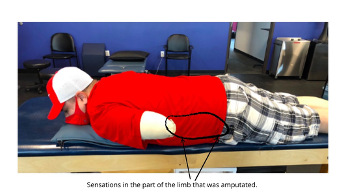
PLS is extremely common in amputees, especially in the first months following amputation. [7] An individual who is experiencing PLS may experience phantom sensation such as:
- Vivid feelings of posture of the limb (ex. limb resting on table)
- Vivid feeling of movement (ex. arm swaying beside the body during walking)
- Feeling of jewelry (rings, bracelets) or clothes
- Feeling pressures of light touch
- Itching or tickle
- Numbness
While PLS is not painful, it can still be an unnerving occurrence for the individual. Some experience PLS in the limb as if it were still attached as normal. Others may experience a phenomenon called telescoping, where the limb is felt shrinking or shortening, going up into the residual limb. [8] Telescoping can occur gradually, or it can occur in a short time. Someone who is experiencing telescoping may feel as if their amputated arm has shrunk and now, they are having sensations of only their hand at the end of the residual limb. [8] There is no specific treatment for getting rid of PLS, however, research has found that for some individuals, sensations may decrease with treatment strategies used for PLP. For some individuals, PLS slowly diminishes over time, however there are many instances where PLS has remained for months to years [8]. As a clinician you can help your patient by discussing with them what sensations they are experiencing, and if these sensations are disturbing their day to day life you can experiment with PLP treatments to see if they decrease their sensations.
PLP, RLP, and PLS are experienced by almost all amputees at some point after amputation. [8] It is important to discuss with your client what they may be experiencing and how it is impacting their daily life. When you understand what type of pain or sensation your client is having after amputation and how it is affecting them, you are then able to provide a treatment approach that will help with their pain and/or sensations.
References
[1] Srivastava D. (2017). Chronic post-amputation pain: peri-operative management – Review. British journal of pain, 11(4), 192–202. https://doi.org/10.1177/2049463717736492
[2] Amputee Coalition (2016, November 22). Managing phantom pain. Retrieved October 18, 2020, from https://www.amputee-coalition.org/limb-loss-resource-center/resources-for-pain-management/managing-phantom-pain/
[3] Finn, S. B., Perry, B. N., Clasing, J. E., Walters, L. S., Jarzombek, S. L., Curran, S., Rouhanian, M., Keszler, M. S., Hussey-Andersen, L. K., Weeks, S. R., Pasquina, P. F., Tsao, J. W. (2017). A randomized, controlled trial of mirror therapy for upper extremity phantom limb pain in male amputees. Frontiers in Neurology, 8. doi:10.3389/fneur.2017.00267
[4] Hanyu-Deutmeyer, A. A., Cascella, M., & Varacallo, M. (2020). Phantom limb pain. StatPearls[Internet].
[5] Poor Zamany Nejatkermany, M., Modirian, E., Soroush, M., Masoumi, M., & Hosseini, M. (2016). Phantom Limb Sensation (PLS) and Phantom Limb Pain (PLP) among Young Landmine Amputees. Iranian journal of child neurology, 10(3), 42–47.
[6] Amputee Coalition (2015, January 3). Management of residual limb pain. Retrieved October 18, 2020, from https://www.amputee-coalition.org/limb-loss-resource-center/resources-for-pain-management/management-of-residual-limb-pain/
[7] Schley, M. T., Wilms, P., Toepfner, S., Schaller, H., Schmelz, M., Konrad, C. J., & Birbaumer, N. (2008). Painful and nonpainful phantom and stump sensations in acute traumatic amputees. The Journal of Trauma: Injury, Infection, and Critical Care, 65(4), 858-864. doi:10.1097/ta.0b013e31812eed9e
[8] Giummarra M. J., Gibsonb S. J., Georgiou-Karistianisa N., Bradshawa J. L. (2007). Central mechanisms in phantom limb perception: the past, present and future. Brain Res. Rev. 54, 219–23210.1016/j.brainresrev.2007.01.009
More To Read
What is Chronic Exertional Compartment Syndrome? Overview and Hand Therapy Treatment Ideas
Compartment syndrome is a condition characterized by increased pressure within a compartment of the body, leading to pain, swelling, and reduced tissue perfusion (Barkay et al., 2021; Buerba et al., 2019). It can be either acute or chronic (Barkay et al., 2021). Chronic exertional compartment syndrome (CECS) is a rare type, most commonly observed in…

Soft Tissue Healing in Pediatrics
By: Chelsea Gonzalez Why do pediatric clients often not require as much hand therapy for soft tissue injuries when compared to adults? The simple answer: Kids have very elastic soft tissue, which can return to its original shape and position after stretch. This elasticity is lost with time as collagen fibers expand and their internal…
Upper extremity weight-bearing tolerance
Barlow, S.J., Scholtz, J. & Medeiros (2020). Wrist weight-bearing tolerance in healthy adults. Journal of Hand Therapy, xxx currently in press. The Skinny Wrist pain and instability are common occurrences and can occur with acute or chronic injuries. This leads to significant dysfunction, including the inability to tolerate axial loading through the upper extremity. There is…
Effectiveness of Conservative Therapy and Splinting for 1st CMC OA
Tsehaie, J., Sprekraijse, K., Wouters, R., Slijper, H., Feitz, R., Hovious, S., & Selles, R. (2018). Outcome of a Hand Orthosis and Hand Therapy for Carpometacarpal Osteoarthritis in Daily Practice: A Prospective Cohort Study. American Society for Surgery of the Hand, 1-11. The skinny: Non-surgical approaches (hand therapy & orthotics) are typically the go-to for…

Sign-up to Get Updates Straight to Your Inbox!
Sign up with us and we will send you regular blog posts on everything hand therapy, notices every time we upload new videos and tutorials, along with handout, protocols, and other useful information.