

THUMB ABDUCTION IN PATIENTS WITH CMC ARTHRITIS? HOW DO YOU MEASURE?
Filed under Evaluation
Article Review
THUMB ABDUCTION IN PATIENTS WITH CMC ARTHRITIS? HOW DO YOU MEASURE?
Corey McGee PhD, OTR/L, CHT , Virginia O’Brien OTD, OTR/L, CHT , Jennifer Skye MS, OTR/L, CHT , Katherine Wall MOT, OTR/L , Thumb Carpometacarpal Palmar and CMC Radial Abduction in Adults with Thumb Carpometacarpal Joint Pain: Inter-rater Reliability and Precision of the Inter-metacarpal Distance Method, Journal of Hand Therapy (2021), doi: https://doi.org/10.1016/j.jht.2021.03.001
THE SKINNY: Hand osteoarthritis is a common condition seen by hand therapists. The thumb joint, in particular, is susceptible to arthritis, and these arthritic changes can lead to contractures of the first webspace, known as a thumb adduction contracture. A common practice for measuring these contracture(s) is to use goniometric measurements to measure radial and palmar abduction, which has been shown not to have the best reliability. The purpose of the study was to determine the inter-rater reliability and precision of using an inter-metacarpal distance method test (IMD) on individuals with CMC arthritis
IN THE WEEDS: Two certified hand therapists of differing clinical and educational backgrounds measured the IMD in patients with a confirmed CMC arthritis diagnosis. The therapist located and marked the 1st and 2nd metacarpal heads at the dorsal midpoints of the joints. A digital caliper was used to measure the distance (mm) between these two points. There were a total of 22 subjects and 28 thumbs.
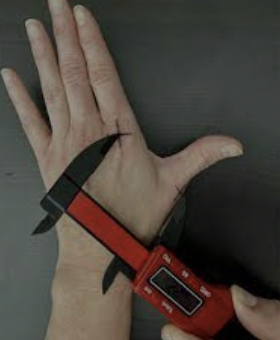
McGee, C, (2021). Figure 3Radial Abduction IMD Measurement. https://www.jhandtherapy.org/article/S0894-1130(21)00041-7/fulltext
BRINING IT HOMEL: Through statistical analysis is was determined IMC for measuring radial and palmar abduction had excellent reliability, and the precision was found acceptable to excellent. Making this IMD a great choice for measuring thumb abduction.
RATING: This article was well written and can change the standard of practice for measuring thumb abduction. CMC arthritis can cause changes in the joint(s) that lead to loss of palmar and radial abduction and other problems that significantly impact hand function. Therapists play an important role in managing CMC arthritis specifically thumb CMC adduction contractures. The IMD is a more accurate way to track clinical changes. Shortcomings of the study include a small number of participants, even though it was adequately powered. This is an excellent article, and I encourage you to read it for more details.
2 Comments
Leave a Comment
More To Read
Peripheral nerve injury: A hand therapist’s assessment of sensory return.
Sensory return after a hand injury specifically a peripheral nerve injury After a peripheral nerve injury, there are often times impairments in sensory function and/or motor function. The rate of recovery varies based on the degree of injury, the overall health of the patient, and the patient’s age. After an injury, it is important…
Splinting and Stretch Protocol for Pediatric Trigger Thumb
Tan, A. C., Lam, K. S., & Lee, E. H. (2002). The Treatment Outcome of Trigger Thumb in Children. Journal of Pediatric Orthopaedics B, 11(3), 256-259. The Skinny:Pediatric trigger thumb is a “relatively uncommon” condition of unknown origins. Studies have indicated that spontaneous recovery of trigger thumb is around 25-40%, and chances increase with age.…

Pediatric & Adolescent Shoulder Instability
Lin, K.M, James, E.W., Spitze, E. & Fabricant, P.D. (2018). Pediatric and adolescent anterior shoulder instability: Clinical management of first-time dislocators. Current opinion in pediatrics, 30, 49-56. doi: 10.1097/MOP.0000000000000566. The Skinny: Shoulder instability for pediatric and adolescent patients is fairly common and is often complicated by a high re-dislocation rate. Shoulder instability typically occurs after…
5+ Common Mallet Finger Splints
Finger orthoses can be tough, and the mallet orthosis is no exception in hand therapy. The protocol for 15 degrees of DIP extension with mallet fingers is tricky to manage while making a common mallet finger splint. Small splints on little fingers are also tricky to get sized just right and with strapping in the…

Sign-up to Get Updates Straight to Your Inbox!
Sign up with us and we will send you regular blog posts on everything hand therapy, notices every time we upload new videos and tutorials, along with handout, protocols, and other useful information.
thanks for sharing! 🙂
Thanks for your commitment and publications to advance our field.
Miranda