

Surgery & Hand Therapy Highlights for Dupuytren’s Disease
Filed under Diagnoses
Dupuytren’s disease affects the fascia of the hand (Dupuytren’s fasciectomy hand). It is relatively common to encounter patients with Dupuytren’s condition, even if that is not the primary reason you are treating the patient. Patients often present with a nodule(s) in the palm of the hand, or they may even have a thickened cord running from their finger(s) to the palm. As the cord thickens, it shortens, leading to the digit being pulled into the palm, causing a joint contracture. The contracture can be either the metacarpophalangeal (MCP) joint or the proximal interphalangeal joint (PIP).
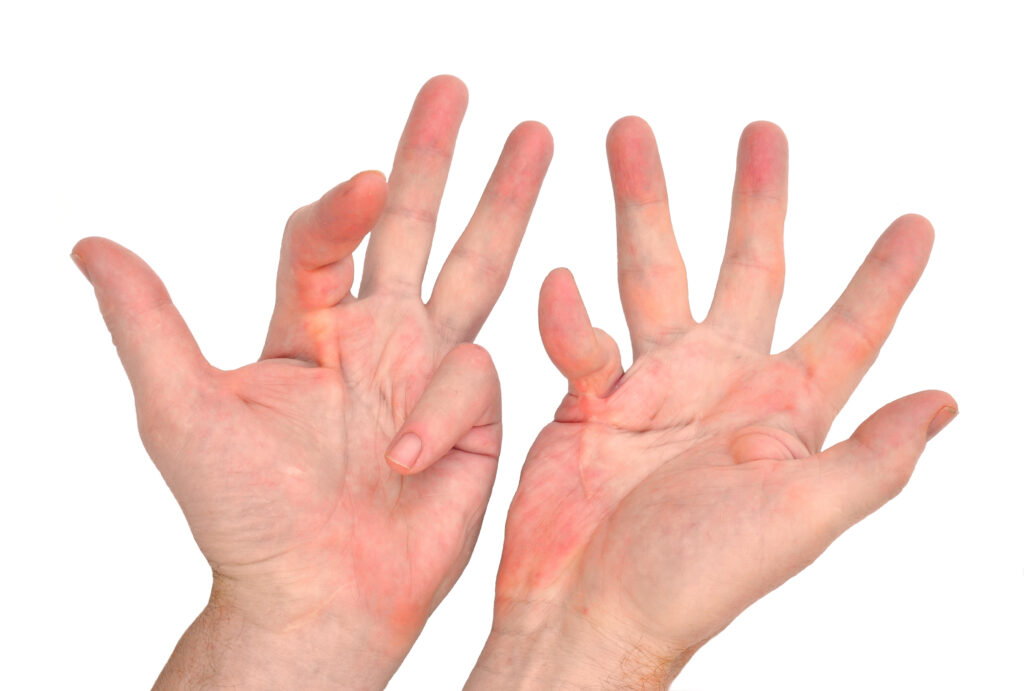
The disease can progress over the years and is most common in males from ages 50-70 years of age. It is more common in those of Scandinavian and Celtic Ancestry. It is also more common in individuals who use alcohol or smoke.
Dupuytren’s more commonly affects the ring and small finger; however, in patients with diabetes, it is more commonly found on the radial side of the hand. Dupuytren’s disease (Dupuytren hand fasciectomy) is diagnosed by physical exam. Radiographic exams and MRIs are usually unnecessary.
What are the options for Dupuytren’s Disease?
There is limited data supporting conservative therapy intervention for the treatment of Dupuytren’s Disease; however, one study showed that night-time extension splinting can be helpful if the patient is not a good surgical candidate (Larcocerie-Salgano and Davidson, 2011).
If the patient has functional limitations due to Dupuytren’s disease, they will often require intervention by a hand surgeon. Other indications are 1.) MCP contracture is greater than 30 degrees or 2.) PIP contracture is greater than 20-30 degrees. These interventions include open fasciectomies, closed fasciotomies, needle fasciotomy, and enzymatic fasciotomy.
What is an Open Fasciectomy?
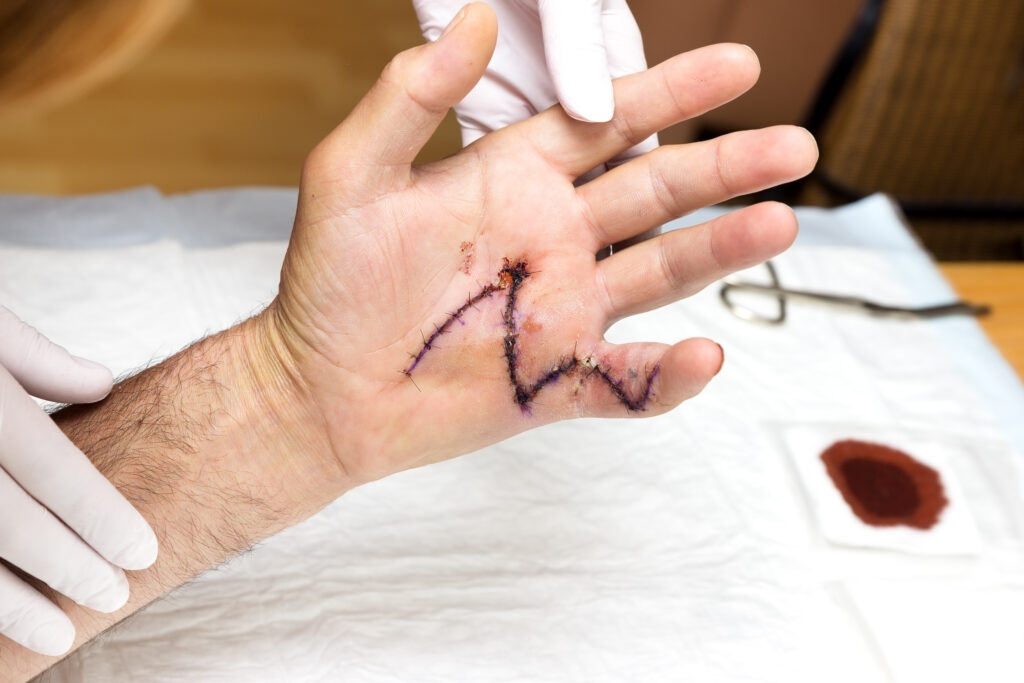
An Open Fasciectomy is where the skin is cut open, and the pathology is easy to visualize and remove. This allows the bulk of the tissue to be excised and the correction of the contracture. There is a wide variety and preferences among surgeons on incision methods. The most commonly reported are the zigzag plasty, the Littler-Brunner incision, the longitudinal incision, and the transverse incisions of McCash’s open palm technique. Dupuytren’s therapy typically consists of early gentle active motion and night-time splinting varying from volar to dorsal approach.
What is an Open Fasciotomy?
An Open Fasciotomy is where the pathologic cords are cut but not removed. This is a preferred treatment as the transverse incision can be left open and patients can start performing range of motion exercises (Dupuytren’s Contracture Exercises) sooner. Depending upon the severity of the disease, the post-operative rehabilitation process needs to be very comprehensive, initially focusing on wound care, splinting with limited tensions, and gentle range of motion while avoiding aggressive therapy. Aggressive therapy can prolong the healing process and lead to poorer results outcomes.
Splinting preferences vary from a volar-based to dorsal-based extension orthosis, depending upon therapist and surgeon preference.
What is a Needle Fasciotomy?
A Needle Fasciotomy is an example of a Closed Fasciotomy. The surgeon performs this by using the beveled edge of a needle to cut the fascial cord while passively extending the digit. Typically there is no wound or incision, and range of motion exercises can be started immediately. Post-procedure splinting options vary and are based on surgeon preference and the severity of the contracture. If a night splint is required, it is typically used for a short 3-4 weeks duration.
What is an Enzymatic Fasciotomy?
An Enzymatic Fasciotomy involves using mixed collagenase injected directly into the Dupuytren’s cord, where it acts to disrupt the collagen bond. As the cord weakens over 24 hours the joint is passively manipulated to release the cord. Some reports state that the manipulation can take place up to 7 days after the initial injection. If the cord does not snap during the manipulation often it will continue to stretch due to its weakened state. Post-procedure all patients are instructed in passive stretching exercises; extension splinting is utilized for 3 months post-procedure.
Hurst, L, Le, T, & MacGillis, K. Surgery Management of Dupuytren’s Disease. Rehabilitation following extensor tendon injury and repair. In Skiven TM, Osterman, AL Fedorczyk, JM, Amadio, PC, Feldscher, SB, Shin EK, eds. Rehabilitation of the Hand and UE. 7th Edition Philadelphia. Mosby Inc; 2021: 223-237.
Larocerie-Salgado, J., & Davidson, J. (2012). Nonoperative treatment of PIPJ flexion contractures associated with Dupuytren’s disease. The Journal of hand surgery, European volume, 37(8), 722–727. https://doi.org/10.1177/1753193411422680
1 Comment
Leave a Comment
More To Read

Wound Healing in Hand Therapy
By: Maddie Mott Wound healing (healing hand therapy) involves a complex series of interactions between different cell types, cytokine mediators, and the extracellular matrix with its four basic stages including hemostasis, inflammation, proliferation, and remodeling (Mackay & Miller, 2003). Because successful wound healing requires adequate blood and nutrients to be supplied to the site of…

A Hand Therapist’s Role in Nutrition Education for Wound Healing
By Brittany Day Role of nutrition in wound healing Nutrition plays an important function in the biological factors that contribute to normal wound healing (wound care nutrition). Patients without nutrient dense diets may experience diminished cell production, collagen synthesis, and wound contraction. There is sparse scientific evidence that explores the exact science behind nutrition and…
Rotator Cuff Pain: K Tape + Rehab Short-Term Effects
Nguyen, T. N. A., Nguyen, N. H., Vu, D. K., & Cu, L. T. N. (2025). Short-term effects ofKinesiotaping combined with a rehabilitation program for rotator cuff-related shoulder pain: Arandomized, assessor-blinded clinical trial. Journal of Manual & Manipulative Therapy, 33(2),112–121. https://doi.org/10.1080/10669817.2024.2387913 The Skinny:The term rotator cuff related shoulder pain (RCRSP) encompasses a range of disordersassociated…
Top 6 treatments for Pinky Fractures
Clients who have experienced a fracture of the finger or hand often find it difficult to participate in meaningful occupations. Everyday tasks from grasping items, cutting food, taking lids off containers, turning keys, and many others can be very painful. Pinky fracture is particularly challenging and painful. This is typical because the largest contributor to…

Sign-up to Get Updates Straight to Your Inbox!
Sign up with us and we will send you regular blog posts on everything hand therapy, notices every time we upload new videos and tutorials, along with handout, protocols, and other useful information.
This is a really helpful guide on Dupuytren’s disease. I’ve had some experience with this condition in my family, and it’s great to see the different treatment options laid out so clearly. I especially appreciate the info on non-surgical options like night-time splinting. It’s good to know what to expect from different treatments and how they might affect recovery. Thanks for making this topic easier to understand!