After hand surgery or an upper extremity injury, most people expect some pain, swelling, and stiffness. What patients do not always expect is how much a scar can affect movement and comfort. Even when an incision looks healed on the outside, the tissue underneath may still feel tight, sensitive, or restricted.
This is where scar massage can help.
Scar massage is a common part of hand therapy once the incision is fully closed and the patient has been cleared by their therapist or surgeon. While many people think scar care is only about appearance, scar massage is also used to improve comfort, skin mobility, and functional hand use.
What Happens as a Scar Heals?
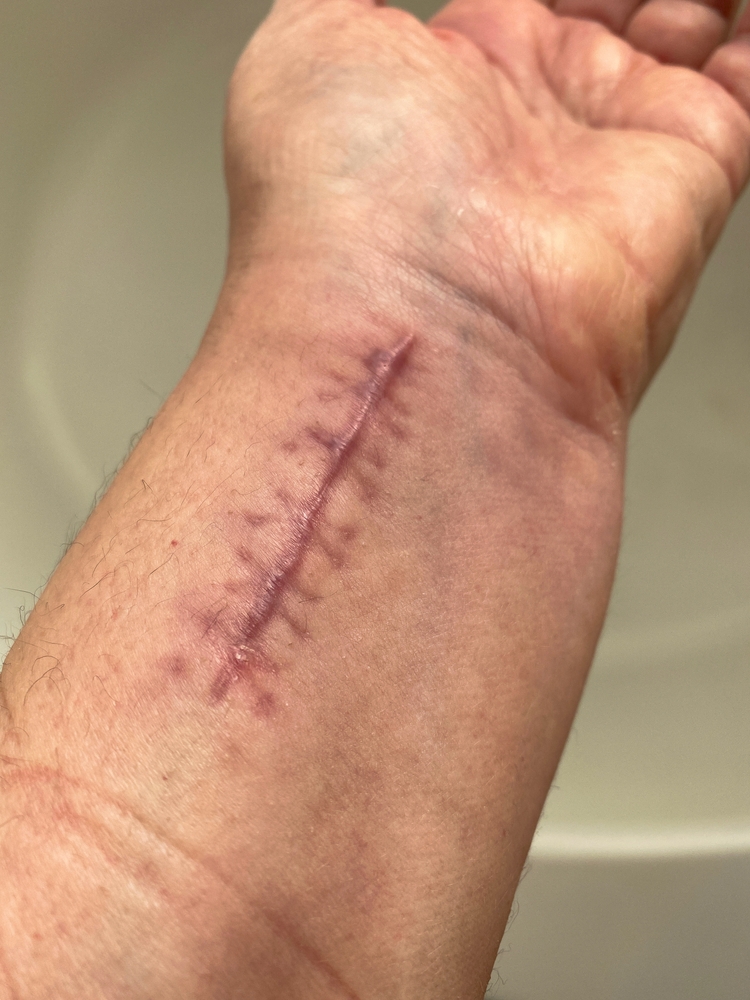
When the body heals after surgery or injury, it creates new tissue to close and protect the area. This is a normal part of healing. Early on, a scar may look red, raised, firm, or sensitive. Over time, scar tissue usually becomes softer, flatter, and more flexible.
Sometimes, however, scar tissue can become tight or stick to the tissues underneath it. In the hand and wrist, this can make a big difference. Tendons, joints, and soft tissue need to move smoothly for normal hand function. If the scar is stiff or restricted, patients may feel pulling, tenderness, or difficulty bending and straightening the fingers, thumb, or wrist.
How Scar Massage Helps
Scar massage helps encourage movement between the skin and the tissue underneath. Gentle pressure and movement over the scar can help the area become more flexible and less sensitive over time.
In hand therapy, scar massage may help:
- Improve scar mobility
- Decrease tenderness or hypersensitivity
- Help firm scar tissue soften
- Reduce pulling or tightness around the scar
- Improve comfort during daily hand use
- Support better motion when scar tightness is limiting movement
For example, after a tendon injury or surgery, scar tissue can sometimes limit how well the tendon moves underneath the skin. In therapy, scar massage may be combined with specific exercises to encourage tendon pull-through and improve motion.
When Should Scar Massage Start?
Scar massage should only begin once the incision is fully closed. This means there should be no open areas, drainage, scabbing, or signs of infection. Starting too early can irritate the incision and interfere with healing.
A hand therapist will check the incision and help determine when scar massage is safe. The timing can vary depending on the type of surgery, how the wound is healing, and any surgeon precautions.
What Does Scar Massage Look Like?
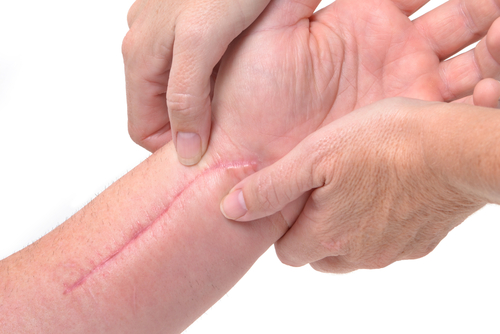
Scar massage usually starts gently. A therapist may begin with light pressure around the scar and then progress to direct massage over the scar once the tissue is ready.
Common scar massage techniques may include:
- Small circles over the scar
- Side-to-side movement
- Up-and-down movement
- Gentle lifting or rolling of the skin when appropriate
- Massage with lotion once the incision is fully healed
The goal is not to aggressively “break up” the scar. More pressure is not always better. Scar massage should be controlled and should not cause increased redness, drainage, or lasting pain.
What About Silicone or Scar Pads?
In some cases, silicone gel sheets, silicone sleeves, or elastomer scar pads may be used along with scar massage. These can help with scar softening, comfort, and pressure management.
A therapist may recommend one of these options if a scar is raised, firm, sensitive, or limiting motion. The type of scar product and wear schedule should be based on the patient’s skin, scar location, and tolerance.
Why Scar Care Matters for Function
Hands are used constantly throughout the day. Even a small area of tight or sensitive scar tissue can affect activities like gripping, pinching, typing, buttoning, writing, cooking, or returning to work tasks.
Scar massage is only one part of a larger hand therapy plan. It is often combined with range of motion exercises, edema management, strengthening, desensitization, and functional activities. The goal is not just for the scar to look better, but for the hand to move and function better.
When to Contact Your Therapist
Patients should let their therapist know if they notice:
- Increased redness or warmth
- Drainage from the incision
- Opening of the incision
- Increased pain after massage
- New numbness or tingling
- A scar that becomes more raised, tight, or painful
Scar healing takes time, and some scars continue changing for several months. With the right guidance, scar massage can be a simple but important part of improving comfort, motion, and daily hand use after surgery.
Takeaway
Scar massage is not just cosmetic. In hand therapy, it can help the scar move better, feel less sensitive, and interfere less with function. Once the incision is fully healed and cleared, consistent scar management can help patients get back to using their hand with more comfort and confidence.
2 Comments
Leave a Comment
More To Read

Use of Proprioception in Rotator Cuff Repair
Article Review By Brittany Day Upper Limb Active Joint Repositioning During a Multijoint Task in Participants with and without Rotator Cuff Tendinopathy and Effect of a Rehabilitation Program Pairot de Fontenay, Benoit, Mercier, Catherine, Bouyer, Laurent, Savoie, Alexandre, & Roy, Jean-Sébastien. (2019). Upper limb active joint repositioning during a multijoint task in participants with and…
The Identification of Mobile Applications for Distal Radius Fractures Rehab.
By Taylor Landholm Chen, Y., Yu, Y., Lin, X., Han, Z., Feng, Z., Hua, X., Chen, D., Xu, X., Zhang, Y., & Wang, G. (2020). Intelligent Rehabilitation Assistance Tools for Distal Radius Fracture: A Systematic Review Based on Literatures and Mobile Application Stores. Computational and Mathematical Methods in Medicine, 2020, 7613569. https://doi-org.methodistlibrary.idm.oclc.org/10.1155/2020/7613569 The Skinny The…
INTEROSSEOUS MUSCLE TIGHTNESS TESTING
May 2012 No. 19 INTEROSSEOUS MUSCLE TIGHTNESS TESTING Judy Colditz, OT/L, CHT, FAOTA INTEROSSEOUS MUSCLE TIGHTNESS TESTING – ARE YOU DOING IT CORRECTLY? The common term “Intrinsic Tightness Testing” is a misnomer as it describes a maneuver specifically designed to test tightness of the interosseous muscles. The interosseous muscles are small, short-fibered muscles contained within…

Video Augmented Hand Therapy after CVA with hemiplegia.
The previous rapid review discussed the positive outcomes of video-augmented hand therapy after a CVA with hemiplegia. Please watch this vlog to discover how to make the video augmented box to make it easily integrated into your clinic. Video By: Shannon Skowbo

Sign-up to Get Updates Straight to Your Inbox!
Sign up with us and we will send you regular blog posts on everything hand therapy, notices every time we upload new videos and tutorials, along with handout, protocols, and other useful information.
Thank you for this summary.
How about the evidence? Does it support scar massage? I often wonder if 3-5 mins of scar massage isn’t better spent on AROM of the surrounding joints and tissues?
The two interventions likely target different aspects of recovery: scar massage primarily addresses scar pliability, thickness, pruritus, and pain, while AROM addresses joint mobility, tendon gliding, and functional recovery. In a time-limited session, the clinical priority should be guided by the patient’s primary limitation. When scar adherence and tightness are the dominant barrier to motion, massage may be a prerequisite to effective AROM. When the scar is supple but joint stiffness or tendon adhesion is the issue, AROM is likely the higher-yield intervention. There is no evidence that 3–5 minutes of scar massage is superior to the same time spent on AROM for functional outcomes.