

Differentiating Proximal Median Nerve Entrapment from Carpal Tunnel Syndrome
Filed under Evaluation, Treatments
By: Brittany Day
Proximal Median Nerve Entrapment, Pronator Syndrome, or Lacertus Syndrome?
Pronator syndrome is a term used to describe proximal median nerve entrapment (PMNE) in the forearm. Pronator syndrome and lacertus syndrome are sometimes used interchangeably to describe proximal median nerve entrapment distal to the ligament of Struthers and proximal to the flexor superficialis arch on the medial side of the forearm (lacertus syndrome vs pronator syndrome). While there is some distinction between the exact location of the compression; the testing, symptoms, and interventions remain similar. The majority of PMNE occur at the level of the lacertus fibrosis sitting superficially to the pronator muscle on the medial aspect of the proximal forearm. Level of compression, provocative testing, symptomology, and interventions of PMNE differ from carpal tunnel syndrome (CTS) and are discussed below.
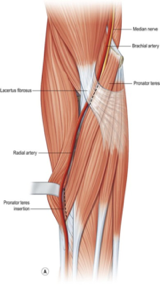
A Diagnostic Conundrum
This illusive syndrome is difficult to diagnose with a need for objective measures as seen through the lens of evidence-based practice. Current diagnostic procedures for PMNE are mostly from subjective clinical findings such as patient self-report and provocative testing. Unlike CTS, a compression at the PMNE will likely not cause the axonal damage found with NCV or EMG. These objective measures generally come back negative for median nerve compression and have a specificity between 30%-70%. MRI results will also likely come back negative for PMNE. A prospective study of 44 participants with PMNE used (1) weakness in median innervated muscles distal to the lacertus fibrosus, (2) pain with palpation over the median nerve at the level of the lacertus fibrosus, and (3) a positive scratch collapse provocative test, as diagnostic criteria.
Signs and Symptoms
Signs and symptoms of PMNE at any level differ from that of CTS and will likely include:
- Loss of lateral pinch and tip pinch strength
- Loss of fine motor skills
- Weakness of FPL, Digit 3 FDP, and FCR found with manual muscle testing
- Pain with palpation of median nerve at the level of the lacertus fibrosis (also known as the bicipital aponeurosis).
- Positive scratch collapse test at level of the lacertus fibrosis
- Pain that likely does not increase at night (a hallmark symptom of CTS)
How to Complete the Scratch Collapse Test for PMNE
- Have patient seated in a chair with feet on the ground, wrists in neutral, and elbows at 90 degrees of flexion
- Patient to resist internal rotation with external force given bilaterally
- Scratch the uninvolved anterior forearm at the level of the lacertus fibrosis and provided external force for patient to resist bilaterally
- Scratch the involved anterior forearm at the level of the lacertus fibrosis and provide external force for patient to resist bilaterally
- A positive test will result in patient “collapsing” into internal rotation with external force
Common PMNE Treatments (lacertus syndrome treatment)
- Non-invasive Treatment – Rest, splinting, and NSAIDs for 3 months
- Injection Treatment – Ultrasound guided perineural injection of median nerve at level of lacertus fibrosis
- Surgical Treatment – Surgical decompression of median nerve with release of lacertus fibrosis
References:
Delzell, Patricia B, & Patel, Mital. (2019). Ultrasound‐Guided Perineural Injection for Pronator Syndrome Caused by Median Nerve Entrapment. Journal of Ultrasound in Medicine, 39(5), 1023-1029.
Hagert E. (2013). Clinical diagnosis and wide-awake surgical treatment of proximal median nerve entrapment at the elbow: a prospective study. Hand (New York, N.Y.), 8(1), 41–46. https://doi.org/10.1007/s11552-012-9483-4
Lalonde, D. (2015). Lacertus syndrome: A commonly missed and misdiagnosed median nerve entrapment syndrome. BMC Proceedings, 9(S3), A74.
3 Comments
Leave a Comment
More To Read

Biceps Tenodesis Versus Tenotomy During Arthroscopic Rotator Cuff Repair
Article Review By: Delaney Wright Title: Outcomes of Biceps Tenodesis Versus Tenotomy During Arthroscopic Rotator Cuff Repair: An Analysis of Patients From a Large Multicenter Database Reference: Srinivasan, R. C., Hao, K. A., Wright, T. W., Farmer, K. W., Wright, J. O., Roach, R. P., Moser, M. W., Freidl, M. C., Pazik, M., & King,…

Stretching Alone Can Change P1 Bone Shape in Patients with Camptodactyly
Woo Hong, S. Kim, J., Sang Kwon, O., Ho Lee, M., Sik Gong, H., Hyun Baek, G., (2019). Radiographic Remodeling of the Proximal Phalangeal Head Using a Stretching Exercise in Patients With Camptodactyly. J Hand Surg Am, 1.e1-1.e10 The Skinny – Camptodactyly is a congenital, nontraumatic flexion contracture of the PIP in fingers other than…

Pillar Pain After Carpal Tunnel Release Surgery
Pillar Pain After Carpal Tunnel Release Surgery Carpal tunnel release (CTR) surgery is a common procedure, with the majority of patients experiencing satisfaction with its outcomes. However, for some individuals, a temporary complication known as “pillar pain” may arise, affecting approximately 13% of those undergoing CTR. Pillar pain manifests in the thenar eminence and hypothenar…
Scar Wars: Scar Management Techniques
We will briefly discuss Scar Management Options and Techniques

Sign-up to Get Updates Straight to Your Inbox!
Sign up with us and we will send you regular blog posts on everything hand therapy, notices every time we upload new videos and tutorials, along with handout, protocols, and other useful information.
Thanks for info.
very clear and educational
Don’t forget to complete Deep Tissue as tolerated. Many of my baseball players benefit from long flexor and extensor stretch. Be certain to pay attention to the neuroanatomy; you don’t want to get punched in the teeth.