3 Different Ways to Incorporate Weighted Balls into Hand Therapy Treatment Sessions:
Filed under Treatments, Uncategorized
By: Kelsey Melton
3 Different Ways to Incorporate Weighted Balls into Treatment Sessions:
Weighted balls can be incorporated into hand therapy treatment sessions in various ways. This is a great therapeutic intervention for many limitations and is simple to grade up or down based on patient needs. Here are some exercise ideas to get you started:
Toss and catch at a rebounder: For this exercise, you will have the patient stand about 2-3 feet from the rebounder, where you will have them throw the ball and then catch as it bounces back to them. This is an excellent exercise for many patients, but some of the ways we use it are for those who need to work on dynamic hand-eye coordination, proprioceptive input, loading through the hand and wrist, and even grip strength. This exercise can be graded up or down based on the weight of the ball, depending on what level the patient is at. Another idea is to have the patient throw with one hand and catch with the other for an added challenge.
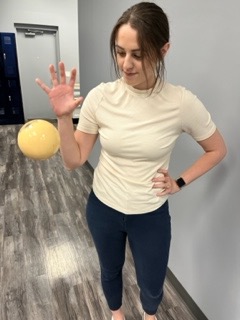
Drop and catch: This exercise is excellent for dynamic hand-eye coordination, proprioceptive input, and grip strength. For this hand therapy exercise, the patient will stand while holding the ball in a pronated position. They will let go and then try and catch the ball before it hits the floor. Depending on the ball’s weight, this can also be graded up or down to adjust treatment based on patient need. To make things more challenging, you can also have the patient walk around the clinic while they complete this exercise to see how they do with dual-task completion.
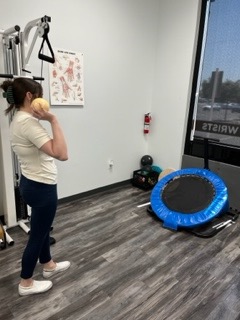
10-2 ball toss: This exercise is a favorite for shoulder stability, gross motor coordination, proprioceptive input, and strengthening, but could be used for countless other limitations. The patient will start facing the wall with their shoulder and elbow at 90 degrees at the 10 o’clock. Making sure that the ball is close to the wall, the patient will begin gently bouncing it against the wall, moving to the 2 o’clock position. They will continue this motion back and forth, trying to maintain the momentum for about 5 minutes, but taking breaks as needed. This activity can be graded up or down in difficulty with the weight of the ball chosen.
Closed chain circles on the wall: For this hand therapy exercise, the patient will be standing facing the wall, similar to how they would for the 10-2 ball toss. With this exercise, they will press the weighted ball against the wall and rotate it in a circle without lifting it. They will continue this for a set amount of time, usually 5 minutes. This is another great exercise to build shoulder endurance and stability as well as proprioceptive input. This can also be graded up or down in difficulty, depending on the ball’s weight.
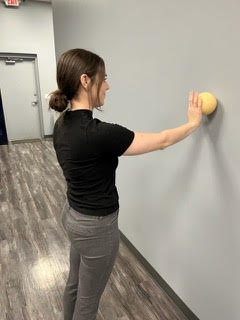
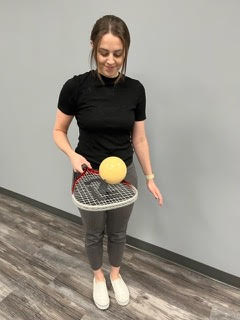
Tennis Racket Carry: This activity is for wrist stability, grip strength, proprioceptive awareness. To recreate this treatment, have the patient standing while holding the tennis racket with their elbow at their side, bent to 90 degrees. The weighted ball will be placed on top of the racket, and they will have to hold this position for 5 minutes with rest breaks as needed. This activity can be graded up or down by sizing up or down in weight, having them walk around while balancing the ball, or you could even have them rotate the weighted ball around the edge of the tennis racket.
3 Comments
Leave a Comment
More To Read
Ways to Improve HEP Compliance in Hand Therapy
Ways to Improve HEP Compliance in Hand Therapy By: Dalton Busch One of the most important ways we see our patient’s progress is by assuring they are compliant with their prescribed home exercise program (HEP). Our patients are always encouraged to adhere to their prescribed program but compliance is easier said than done. Reminding patients…

Ultrasound use for reducing pain: Does it work?
Ilter, L., Dilek, B., Batmaz, I., Ulu, M.A., Sariyildiz, M.A., Nas, K., & Cevik, R. (2015). Efficacy of pulsed and continuous therapeutic ultrasound in myofascial pain syndrome: A randomized controlled study. American Journal of Physical Medicine & Rehabilitation, 94(7), 547-554. https://doi.org/10.1097/PHM.0000000000000210 Review by: Megan Prather The Skinny- Ultrasound hand therapy – ultrasound has been determined…

Carpal Tunnel Treatment: Splinting Only vs Splinting & Conservative Treatment
Short-term clinical outcome of orthosis alone vs combination of orthosis, nerve, and tendon gliding exercises and ultrasound therapy for treatment of carpal tunnel syndrome. Sim, Sze En et al. Journal of Hand Therapy, Volume 32, Issue 4, 411 – 416 The Skinny- Carpal tunnel syndrome (CTS) is the most common compression neuropathy. Compression of the…
Graded Motor Imagery in Hand Therapy
The 3 Stages of Graded Motor Imagery We’ve all heard of mirror box therapy, but do you know the details of how it works? There’s actually 3 stages involved that exercise the brain and take advantage of its plasticity. There is a great deal of evidence supporting these three stages and you can use them…

Sign-up to Get Updates Straight to Your Inbox!
Sign up with us and we will send you regular blog posts on everything hand therapy, notices every time we upload new videos and tutorials, along with handout, protocols, and other useful information.
I will also have patients complete the drop and catch by starting in pronation but catching in supination. I will also have patients toss ball from hand to hand varing the speed and distance.
Could use a more clear description of 10-2 and the Drop and Catch. It’s hard to understand what you mean. But overall useful ideas, thanks!
We will work on getting some videos together, we will post them on our IG page @handtherapyacademy.com