

Carpal Tunnel Release Remains Effective in Patients With Double Crush Syndrome and Cervical Radiculopathy
Filed under Uncategorized
Hansen, L. M., Jiang, E. X., Hodson, N. M., Livingston, N., Kazanjian, A., Wu, M., & Day, C. S.
(2024). Patients With and Without Double Crush Syndrome Achieve Similar Rates of Clinical
Improvement Following Carpal Tunnel Release. HAND, 20(4), 549–554.
https://doi.org/10.1177/15589447241233764
By: Mia Soto
The Skinny:
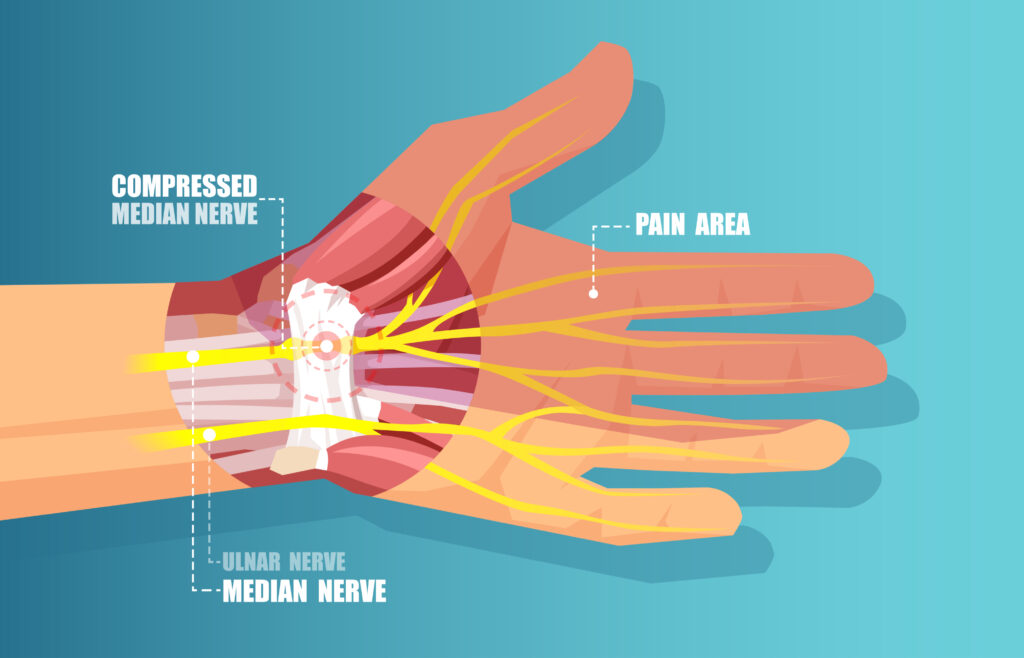
The aim of this study was to compare outcomes of Carpal Tunnel Release (CTR) between
individuals with preoperatively diagnosed Double Crush Syndrome (DCS) and those without.
The authors hypothesized that patients with DCS will have decreased improvement in their
patient-reported outcome measures (PROM) scores post CTR than those without. Additionally,
they hypothesized that the individuals with DCS will achieve the minimal clinically important
difference (MCID) for each score at decreased rates than those without DCS.
In the Weeds:
This retrospective cohort study included patients who had preoperative nerve conduction
studies (NCS) and underwent isolated, unilateral CTR between 2020-2022. Participants were
placed in groups for those with Carpal Tunnel syndrome (CTS) only and those with DCS (CTS
plus cervical radiculopathy [C5 -T1]). Outcomes were assessed preoperatively and around 3-4
months postoperatively using the patient-reported outcomes measurement information system
(PROMIS) upper extremity (UE), PROMIS pain interference (PI) scales, the QuickDASH
questionnaire, and a 7-level anchor question regarding overall function. Minimally clinically
important difference (MCID) thresholds were applied. To control for differences in baseline
characteristics, a propensity-matched analysis was preformed to create a 2:1 ratio based on age,
sex, and CTS severity.
Bringing it Home:
Of the 178 patients included in the study, 115 had CTS only and 63 had DCS. Prior to the
matched analysis, DCS patients were found to be older, more often male and had more severe
cases of CTS. These differences were balanced after the propensity matching. Both groups had
reported significant postoperative improvement in the PROMIS UE, PROMIS PI, and
QuickDASH scores. However, there were no significant differences between CTS-only and DCS
patients in absolute score or degree of change. Across all groups, rates of achieving MCID were
similar, and the anchor question responses showed comparable levels of perceived
improvements, most reporting with “improved” or “much improved”. These results suggest that
having cervical radiculopathy did not diminish early outcomes after CTR, supporting CTR as an
appropriate first-line intervention even when double crush is present.
Rating:
3/5 – The study addresses important clinical research with a moderate sized cohort,
validated outcome measures, and a propensity-matched analysis. However, the study lacked a
long-term follow up with the participants and relied on interpretation of NCS which limits the
strength of the conclusions. The study highlights how CTR can be a reasonable first-line
intervention for individuals with DCS, but additional research can confirm these results.
Reference:
Hansen, L. M., Jiang, E. X., Hodson, N. M., Livingston, N., Kazanjian, A., Wu, M., & Day, C. S.
(2024). Patients With and Without Double Crush Syndrome Achieve Similar Rates of Clinical
Improvement Following Carpal Tunnel Release. HAND, 20(4), 549–554.
https://doi.org/10.1177/15589447241233764
More To Read

Prevention and Management of Upper Extremity injuries in Modern Mass Production
Injuries and Upper Extremty Pitts, G., Custer, M., Foister, R. D., & Uhl, T. (2021). The hand therapist’s role in the preventionand management of upper extremity injuries in the modern mass production industrial setting.Journal of Hand Therapy, 34(2), 237–249. https://doi.org/10.1016/j.jht.2021.04.019 By: Kaylen Kallander The Skinny: This study included four case studies to determine the impact…

Comparing the Rates of Recovery Among Four Common Shoulder Surgeries
Rapid Review By: Case Peters Comparing the Rates of Recovery Among Four Common Shoulder Surgeries Grubhofer, F., Martinez, A.R.M., Ernstbrunner, L., Haberli, J., Selig, M.E., & Warner, J.J. (2021) Speed of recovery of the most common performed shoulder surgeries. JSES International.5(4); 776-781. doi: 10.1016/j.jseint.2021.03.007 The Skinny: Setting realistic expectations for the trajectory of recovery is…
What is the real job of the Lumbricals?
Crowley, J. S., Meunier, M., Lieber, R. L., & Abrams, R. A. (2020). The Lumbricals Are Not the Workhorse of Digital Extension and Do Not Relax Their Own Antagonist. The Journal of Hand Surgery. The Skinny: What do the lumbricals do? There is a long-standing belief that the lumbricals act as a counterforce to the…
Flexor tendon rehabilitation in the 21st century: A systematic review
Neiduski, R. L. & Powell, R. K. (2019). Flexor tendon rehabilitation in the 21st century: A systematic review. Journal of Hand Therapy, 32, 165-174. The Skinny The objective of the study was to determine if there was evidence to support 1 type of exercise regimen. Exercise regimens reviewed include place and holds, early passive or…

Sign-up to Get Updates Straight to Your Inbox!
Sign up with us and we will send you regular blog posts on everything hand therapy, notices every time we upload new videos and tutorials, along with handout, protocols, and other useful information.