Live CEU Courses for Occupational Therapists: The Ultimate Guide to Learning and Growth
Filed under Uncategorized
Introduction to Live CEU Courses
Continuing education is a cornerstone of professional development in healthcare, and for occupational therapists, it’s not just a recommendation—it’s often a requirement. Live CEU courses for occupational therapists provide the perfect balance of structured learning, peer interaction, and hands-on training that self-paced online modules often lack.
Whether you’re a new graduate looking to sharpen your skills or a seasoned professional seeking to stay updated with the latest techniques, live CEU courses can help you expand your knowledge and boost your confidence in clinical practice.
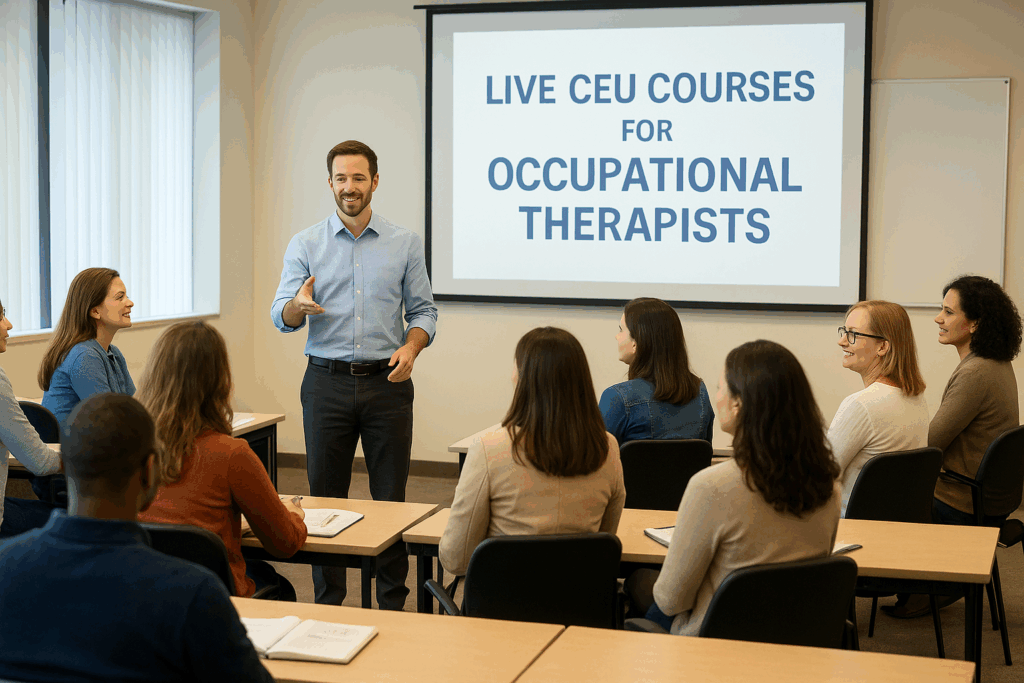
What Are CEU Courses in Occupational Therapy?
CEU stands for Continuing Education Units. These courses ensure that occupational therapists remain up to date with emerging research, treatment techniques, and best practices. Each course earns you credits that can be applied toward state licensure renewal requirements.
Why Occupational Therapists Need Continuing Education
Occupational therapy is constantly evolving with new evidence-based interventions. CEUs allow therapists to:
- Stay compliant with licensure laws.
- Improve patient outcomes with updated practices.
- Explore specialized areas such as pediatrics, geriatrics, or hand therapy.
- Enhance professional credibility and career opportunities.
Benefits of Live CEU Courses for Occupational Therapists
Real-Time Interaction with Instructors
Unlike pre-recorded courses, live CEUs let you ask questions and receive immediate feedback, which deepens your understanding of complex concepts.
Networking Opportunities with Peers
These courses often bring together therapists from different specialties, creating opportunities to exchange insights, share challenges, and even collaborate professionally.
Hands-On Skill Development
For techniques that require practice—like manual therapy, splinting, or sensory integration—live courses provide invaluable hands-on demonstrations.
Comparing Live vs. Online CEU Options
Flexibility and Accessibility
- Online CEUs: Study anytime, anywhere.
- Live CEUs: Offer structure and accountability.
Cost and Value Differences
While online options may be cheaper, live courses often provide added value in skill mastery and direct mentorship.
Which Option Fits Your Learning Style?
If you thrive on interaction, feedback, and practical demonstrations, live CEUs are the superior choice.
Popular Topics in Live CEU Courses for Occupational Therapists
Hand Therapy and Fine Motor Skills
Specialized training in splinting, upper extremity rehab, and fine motor skill recovery.
Pediatric Occupational Therapy
Learn strategies for working with children who have developmental delays, autism, or sensory processing disorders.
Geriatric Rehabilitation
Gain expertise in fall prevention, dementia care, and mobility training.
Neurological and Cognitive Rehabilitation
Stay updated on stroke rehabilitation, traumatic brain injury recovery, and memory interventions.
How to Choose the Right CEU Course
Accreditation and State Requirements
Always verify that the course is recognized by your state licensing board.
Instructor Expertise and Credentials
Look for instructors with real-world clinical experience and strong academic backgrounds.
Course Reviews and Alumni Feedback
Check feedback from past participants to ensure quality and relevance.
Best Platforms Offering Live CEU Courses for Occupational Therapists
- AOTA (American Occupational Therapy Association) – The gold standard for OT education.
- HandTherapyAcademy.com – Known for high-quality interactive sessions.
- University & Hospital Programs – Often provide cutting-edge, research-backed training.
Learn more about CEU accreditation at the official AOTA website.
Tips to Maximize Learning in Live CEU Courses
- Prepare Before Attending – Review course materials in advance.
- Take Notes Effectively – Use bullet points and highlight key techniques.
- Apply Knowledge in Daily Practice – Reinforce learning by immediately applying new strategies with patients.
FAQs about Live CEU Courses for Occupational Therapists
Q1. How many CEUs do occupational therapists need per year?
Requirements vary by state, but most require between 12–24 CEU hours annually.
Q2. Are live CEU courses more expensive than online ones?
Yes, generally, but the investment often pays off through skill mastery and networking.
Q3. Can live CEU courses be counted toward license renewal?
Absolutely—provided they’re accredited by a recognized body like AOTA.
Q4. How do I find upcoming live CEU workshops near me?
Check professional associations, university events, and continuing education platforms.
Q5. Do employers reimburse CEU course costs?
Many healthcare organizations do offer reimbursement—always ask your HR department.
Q6. Can I combine live and online CEUs to meet my requirements?
Yes, most boards accept a mix, but check state-specific guidelines.
Conclusion: Advancing Your Career with Live CEU Courses
Live CEU courses for occupational therapists are more than just a requirement—they’re a powerful tool for growth, innovation, and career advancement. They offer opportunities for networking, practical skills, and real-time feedback that online options can’t always match. By investing in live education, you’re not only meeting licensure requirements but also elevating your professional impact.
More To Read

Hand Therapy Interventions for Distal Upper Extremity Injuries and Conditions
Takata, S.C., Wade, E.T., & Roll, S.C. (2019). Hand therapy interventions, outcomes, and diagnoses evaluated over the last 10 years: A mapping review linking research to practice. Journal of Hand Therapy, 32(1), 1–9. Written by Brittany Carrie The Skinny Approximately 26.9% of orthopedic injuries and disorders of the upper extremity occur worldwide. Injuries are most…
Differentiating Proximal Median Nerve Entrapment from Carpal Tunnel Syndrome
By: Brittany Day Proximal Median Nerve Entrapment, Pronator Syndrome, or Lacertus Syndrome? Pronator syndrome is a term used to describe proximal median nerve entrapment (PMNE) in the forearm. Pronator syndrome and lacertus syndrome are sometimes used interchangeably to describe proximal median nerve entrapment distal to the ligament of Struthers and proximal to the flexor superficialis…

Mirror Therapy
Mirror therapy has many implications for therapy and can be used to treat many diagnoses that commonly involve the upper extremity. These include some of the Neuro Conditions we highlighted last week including, Stroke and Focal Hand Dystonia. Btw, you can download a mirror therapy exercises pdf here for free. How long should the patient…
Effectiveness of Conservative Therapy and Splinting for 1st CMC OA
Tsehaie, J., Sprekraijse, K., Wouters, R., Slijper, H., Feitz, R., Hovious, S., & Selles, R. (2018). Outcome of a Hand Orthosis and Hand Therapy for Carpometacarpal Osteoarthritis in Daily Practice: A Prospective Cohort Study. American Society for Surgery of the Hand, 1-11. The skinny: Non-surgical approaches (hand therapy & orthotics) are typically the go-to for…

Sign-up to Get Updates Straight to Your Inbox!
Sign up with us and we will send you regular blog posts on everything hand therapy, notices every time we upload new videos and tutorials, along with handout, protocols, and other useful information.