

Shoulder Pain: The Effectiveness of Conservative Treatment
Filed under Reviews
Reference:
Steuri, R., Sattelmayer, M., Elsig, S., Kolly, C., Tal, A., Taeymans, J., & Hilfiker, R. (2017). Effectiveness of conservative interventions including exercise, manual therapy and medical management in adults with shoulder impingement: a systematic review and meta-analysis of RCTs. British journal of sports medicine, 51(18), 1340–1347. https://doi.org/10.1136/bjsports-2016-096515
By: Tayler Roost
The Skinny: This study was a systematic review and meta-analysis completed on the effectiveness of all relevant non-surgical interventions for shoulder pain and impingement.
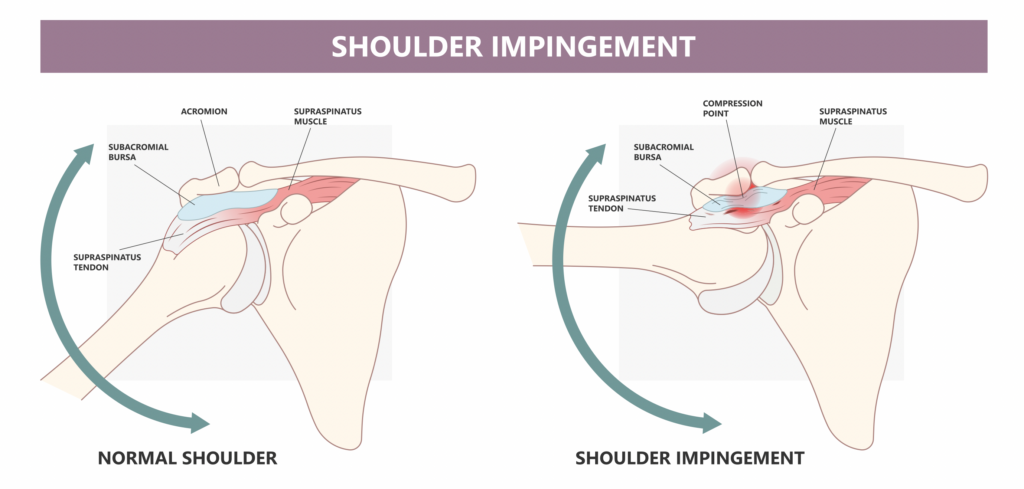
In the Weeds: 200 randomized controlled trials were analyzed to determine the most effective conservative interventions to treat shoulder pain and impingement. Patient inclusion criteria for each of the trials were as follows:
- 18 years or older
- Complaints of shoulder pain (pain arc between 40 degrees and 120 in abduction and flexion)
- Pain with active arm elevation
- Tenderness to palpation of rotator cuff tendons
- Resisted painful or weak shoulder external rotation and shoulder abduction
- Positive Neer, Hawkins-Kennedy, Speed, Jobe, or Empty can test
- At least one conservative intervention used
The considered parameters for each study encompassed pain, functionality, and the active range of motion.
Bringing it home: This analysis discovered that ultrasound-guided corticosteroid injections and targeted exercises addressing the rotator cuff musculature yielded the greatest benefits in pain relief and improved functionality. Additionally, the combination of manual therapy and exercise demonstrated effectiveness in pain alleviation, particularly showing more immediate effects during shorter follow-up appointments. Laser therapy was identified as effective in pain alleviation as well. Notably, active range of motion exercises exhibited superior effects compared to non-exercise therapy modalities.
Rating: 4/5
This review revealed that the overall quality of evidence for each modality was notably low, primarily due to a heightened risk of bias, imprecise data, inconsistent findings, and clinical heterogeneity (Steuri et al., 2017). While acknowledging the limited individual efficacy of these modalities, the study underscores the potential effectiveness of employing multiple approaches concurrently to address shoulder impingement. Despite the collective low quality, the study emphasizes that opting for conservative treatment is more advantageous than abstaining from any intervention. Furthermore, it advocates for tailoring the treatment approach to the specific needs of each patient.
More To Read
Common Median Nerve Injuries
Common Median Nerve Injuries By: Madison Mott Did you know!? Aside from the most common upper extremity nerve compression, carpal tunnel syndrome (CTS), there are several additional median nerve injuries. Pronator SyndromeCompression of the median nerve between the two heads of pronator teres. Result of recurrent, forceful gripping, forearm rotation, or elbow flexion. Signs include…
Read More
Differential Diagnosis: Trigger Finger vs. Subluxing Sagittal Band Injury vs. Subluxing Lateral Band
Differential Diagnosis: Trigger Finger vs. Subluxing Sagittal Band Injury vs. Subluxing Lateral Band Hand therapists frequently encounter patients presenting with finger pain, clicking, and difficulty with tendon glide. Among the most commonly confused conditions are trigger finger, subluxing sagittal band injury, and subluxing lateral band. Each of these pathologies involves different anatomical structures and biomechanical…
Read More
Does Obesity or Smoking change the outcomes for Distal Radius Fractures
Hall, Matthew J., Ostergaard, P., Dowlatshahi, A., Harper, C., Earp, B. Rozental, T. (2019). The Impact of Obesity and Smoking on Outcomes After Volar Plate Fixation of Distal Radius Fractures. The Journal of Hand Surgery. In Press, Corrected Proof, Available online 31 October 2019. Doi: https://doi.org/10.1016/j.jhsa.2019.08.017 The Skinny- Distal radius fractures are one of the…
Read More
Early Mobilization After Volar Locking Plate Osteosynthesis of Distal Radius Fractures in Older Patients: A Randomized Controlled Trial
By: Rachel Reed Sørensen, T. J., Ohrt-Nissen, S., Ardensø, K. V., Laier, G. H., & Mallet, S. K. (2020). Early Mobilization After Volar Locking Plate Osteosynthesis of Distal Radial Fractures in Older Patients-A Randomized Controlled Trial. The Journal of hand surgery, S0363-5023(20)30276-8. Advance online publication. https://doi.org/10.1016/j.jhsa.2020.05.009 The Skinny: The purpose of this randomized controlled trial was…
Read More
Sign-up to Get Updates Straight to Your Inbox!
Sign up with us and we will send you regular blog posts on everything hand therapy, notices every time we upload new videos and tutorials, along with handout, protocols, and other useful information.